DIGITAL RIGHTS AND RESPONSIBILITIES |
 |
Unit Overview
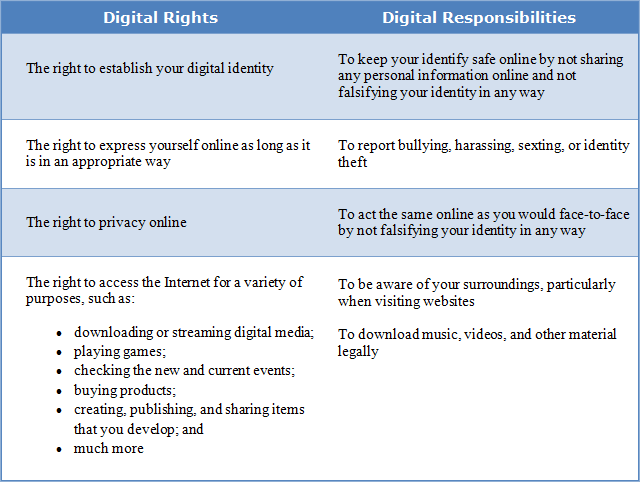
Digital rights and responsibility include your online behavior, attitude, and choices. Digital rights give you the freedom to make decisions and establish your online identity. The decisions you make are your digital responsibility. You have the right to establish your digital identity; however, you have the responsibility to keep your identity safe while online. Your freedom of speech also applies to technology. You can say whatever you want as long as you are not violating others’ rights. Your digital responsibility is to report bullying, harassing, sexting, or identity theft when you become aware of these misbehaviors. You also have the right to privacy online. Your privacy rights give you the choice to give out your information, but you should not invade others’ privacy, such as hacking Facebook accounts or forwarding photos of those sent to you. You have the right to access the Internet for a variety of reasons. Along with this right though, you must be aware of the websites you visit and legally download music, videos, and other material. Below is a chart to emphasize these digital rights and responsibilities.
 |
Click on the following prezi presentation to view the content digital rights and responsibilities.
Your Online Identity
What are the consequences of growing up in a society that always remembers and never forgets? As a Digital Native who has grown up during the age of digital technology and is familiar with electronic devices and the Internet, you probably have been recorded from birth.  Then, this information about you has been retained and remains accessible to others. Additionally, what others post about you may reveal aspects of your life that you do not want others to know. So, what information is online about you and do you want others to know it? Then, this information about you has been retained and remains accessible to others. Additionally, what others post about you may reveal aspects of your life that you do not want others to know. So, what information is online about you and do you want others to know it? You spend many hours plugged into the virtual world and maintain two identities: a real-life self and a digital self, which is presented in social networking profiles, emails, text messages, and online accounts. You are entrenched in the online world, but do you really know how to create and control your virtual identity? Your online identity is how the world perceives you on the web. Why should you care about your online identity? |
You can hurt yourself when you reveal too much information. Inappropriate pictures, videos, and conversations posted online may come back to haunt you. Ask these questions before putting content online:
|
So, how much time should you spend managing your online identity? The answer is unclear; however, you should spend much more time establishing your actual self rather than inventing your virtual self. But in thinking about your virtual self, please make it appear as your actual self.
Click on the following YouTube video to watch a brief video on digital dossier.
Express Yourself
In Unit 5 you learned the basic rules to follow when texting or chatting, on your cell phone, playing online games, and emailing. As teens, you gather on social networking sites to gossip, support one another, jockey for status, collaborate, share information, flirt, joke, and goof around. Friendship while very important has potential consequences with social networking. In this section you will learn proper etiquette for expressing yourself through social networking sites, such as Facebook and Twitter.
Click on the following link to read about proper social networking etiquette for Facebook and Twitter: https://www.sociableblog.com/2010/04/01/50-crucial-rules-social-media-etiquette-for-students/. |
With the fun of social networking comes the responsibility to report bullying, harassing, sexting, or identity theft. If you noticed improper activities going on at your neighbor’s home, would you ignore the issue? You probably answered No! While you should not attempt to stop the home intruders yourself, the same is true of irresponsible actions on social networking sites. First, you should never bully or harass others or be a part of those misdeeds. So, if you witness bullying, harassing, or misbehavior online by others, you should report the offender immediately to an adult, school staff, or police if the actions are severe.
Click on the following YouTube video to watch a brief video on the consequences of posting inappropriately on Facebook.
| Digital Privacy Most things you do online from searching on Google to changing your Facebook status are recorded and remain permanent. One amateur hacker or a group of bullies who steals a password or shares inappropriate information can do serious damage to your sense of personal privacy. So what can you do to protect your privacy? The best way to maintain privacy is to use strong measures to conceal information stored on your cell phone, laptop, netbook, or desktop. Your login password is the way the computer verifies that someone logging in is really you, so pick something that cannot be guessed by others. When it comes to passwords for online services, here is a list of things to consider: |
 |
|
Are your passwords secured?
Click on the following YouTube video to watch a brief video on digital privacy.
Click on the following YouTube video to watch a brief video on digital privacy.
Access the Internet
You have the right to connect on the Internet for:
|
 |
You also have the right to connect with digital media (music, video, games) via mobile technology, which is the most popular method for teens. To legally listen to music or watch videos, you must understand the difference between streaming and downloading. Streaming digital media means receiving the media as it is presented from an external source (Internet). Live streaming refers to content delivered over the Internet in real time. Downloading media involves transferring and copying media from the Internet to a laptop, desktop, netbook, or cell phone.
If you are going to listen to music or watch video in a place with an Internet connection or on your cell phone, a few free music streaming services with phone apps are Spotify and Pandora. These sites offer almost every song you will ever want although you have little control over which songs will play.
With streaming so easy, downloading songs or video and storing them on your device just isn’t necessary anymore. Video on demand for a price are systems like Netflix, which allow users to select and watch/listen to video content when they choose rather than having to watch at a specific broadcast time. However, if you often listen to music or watch videos in places where Internet connections are slow, spotty, or nonexistent or you want to keep a copy of the media for listening or watching later, you will want to download the media. Although the Internet has made it easy to get a free downloads of digital media, illegally downloading digital media is an ongoing problem in our society. You must understand that this is not only disrespectful to the artists and producing companies, but it is against copyright law.
Click on the following link to read about the legal options for downloading, sharing digital media, and receiving video on demand https://www.udel.edu/legaltunes/. |
Summary
In today’s world you have digital rights and responsibilities. When you violate other’s rights or make unsafe and inappropriate choices, there are consequences. Penalties may include writing apology letters; paying back for misdeed; and loss of privileges, such as a curfew, limited technology use (cell phone, computer, or video game access), reduction on allowance, restricted driving, and community service.. More severe misconduct may get you suspended from school, land you in legal trouble, or ban you from technology access at school.