Course Overview
Music history is a reflection of the history of our world and/or country. Each country has developed a specific music giving it its own humanistic value. With extensive world travel music has grown to encompass many cultures and venues resulting in many blended styles. Music Appreciation gives us a chance to understand and appreciate each period of history: how it has influenced the past, present, and how it will affect the future. This course is designed to give students a taste of the music and culture from each designated period in the timeline of music history. The topics will be covered with the use of video to help comprehend the era in which each style of music was incorporated. Many audio pieces will give the student a feel for the spectrum of music history, its composers, and/or their repertoires. Music Appreciation will help students gain a better understanding of and a new appreciation for the world of music.
introduction to Music Appreciation

Music of the Middle Ages (450-1450)
Dating back to around 1000 B.C., it was the Greeks who had developed the
language of music. Even after being defeated by the Romans, the Greek
musical ideas remained dominant in the Roman culture. In order for music
to be fully appreciated in Greek society, it needed to have a solid foundation
relating to the science field. As a result, scientific rationales started
to relate the tuning of music, instruments, modes (melodic formulas
based on certain scales), and rhythms.  Pythagoras,
a famous mathematician pictured at the left, was the first to discover and
write about the ratio of vibrations that corresponds to each note used in
Western music. From these tones, came the various scales and modes used
in writing music. The system of rhythmic notation was based on poetry and
focused on its long-short relationships. The Romans added to these
musical ideas with their invention of the seven-note scale, the diatonic
scale, which became and has remained the standard. The Romans also
changed the focus of rhythms from their long-short relationships to equal
durations that focused on accents.
Pythagoras,
a famous mathematician pictured at the left, was the first to discover and
write about the ratio of vibrations that corresponds to each note used in
Western music. From these tones, came the various scales and modes used
in writing music. The system of rhythmic notation was based on poetry and
focused on its long-short relationships. The Romans added to these
musical ideas with their invention of the seven-note scale, the diatonic
scale, which became and has remained the standard. The Romans also
changed the focus of rhythms from their long-short relationships to equal
durations that focused on accents.
The first accounts of music date back to biblical times and were used mostly for religious purposes. We think of this in accordance with the book Psalms found in the Old Testament of the Bible. Most written records of music begin in the Middle Ages. In music history, this is the time period between 450 and 1450 A.D. This period in history is also referred to as the Dark Ages or the Medieval Times.
Sacred music dominated the music of the Middle Ages as did the powerful influence of the Roman Catholic Church. Cathedrals were the most popular architectural structure and were also the center of music. Priests took on the role of liturgical singers, and young boys were educated about music to be used in this way. The only women that were permitted to sing were the Nuns that lived in the convents associated with the church. Most medieval music was vocal because instruments had played a role in the earlier pagan rites. However, after about 1100, instruments were more widely used in church services, primarily the organ.
The official music of the Roman Catholic Church has been Gregorian chant for the last 1,000 years. Gregorian chant has one melody set to sacred Latin texts and is sung without accompaniment, resulting in the chant having a monophonic texture meaning one melody sung by itself. In the early days of these chants, they were passed down through oral repetition, but as the number of chants increased, so too did the need to notate them for both rhythmic and lyric accuracy. Please watch the following video:
Music slowly started spreading outside the walls of the church. Music that is not performed for religious purposes and does not contain religious lyrics is known as secular music. During the 12th and 13th centuries, French nobles called troubadours began composing music. During this time, chivalrous knights earned a great deal of respect as musical poets. The knights’ songs were usually performed by court minstrels and were written as love songs, dance songs, and about the Crusades.
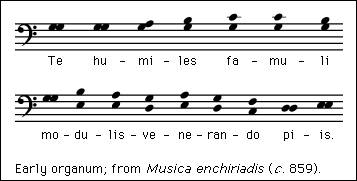
Sometime between 700 and 900 A.D., the Monks of the monastery choirs began to add a second melodic line to Gregorian chant, resulting in a polyphonic texture, meaning more than one melody being sung or played at the same time. Organum is the term used for medieval music that has Gregorian chant and one or more additional melodic lines.
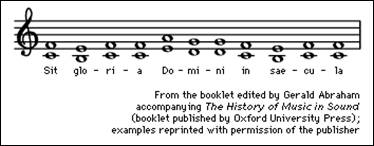
In early polyphonic music, the first melody and second melody moved parallel with each other and were very dependent on each other rhythmically. For example, if the first melody went higher, so too did the second melody, and they both contained identical rhythms.
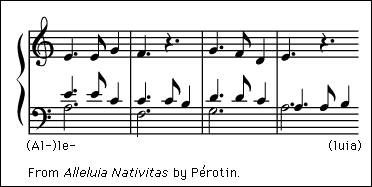
It was not until later between 900 and 1200 that organum became truly polyphonic. The chant always corresponded with the first melody. The second melody started to become more independent from the chant. Its melodic line began to have a curve often moving in opposite directions of the chant. Eventually around 1100, the chant and the melody also started differing rhythmically.
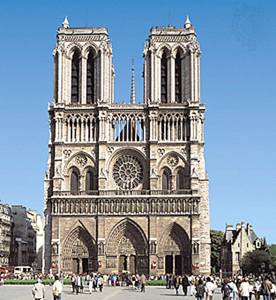
Cathedral of Notre Dame
 During the 12th and 13th
centuries, Paris, France was the artistic and intellectual capital of Europe
and it was during this time that the great Cathedral of Notre Dame was
built. This became known as one of the most prolific examples of Gothic architecture.
Notre Dame took almost a century to build. Perotin, the composer
of the musical example above, and another man by the name of Leonin were
early choirmasters at Notre Dame, and actually became the first notable
composers known by name. Their compositions were among the first to be
read from notation instead of being improvised.
During the 12th and 13th
centuries, Paris, France was the artistic and intellectual capital of Europe
and it was during this time that the great Cathedral of Notre Dame was
built. This became known as one of the most prolific examples of Gothic architecture.
Notre Dame took almost a century to build. Perotin, the composer
of the musical example above, and another man by the name of Leonin were
early choirmasters at Notre Dame, and actually became the first notable
composers known by name. Their compositions were among the first to be
read from notation instead of being improvised.
Their music was also the first to use definite time values and a clearly defined meter. Today we call this the time signature. Their compositions were also the first of its kind to contain more than two independent voices. It made their music sound more elaborate and ornate which fit in perfectly with the impressive architecture and detail of the Notre Dame Cathedral. This attention to detail and ornamentation of the chant was especially used during important services and celebrations at the cathedral.
Notre Dame Composers created a new genre of music in the early thirteenth century called motets. At first a motet was written to add texts to the upper voices of a chant. Typically, the chant itself was written in what we know as the tenor line of the music. This meant that they were also adding words to the upper voices (what we think of today as the alto and soprano lines).
As a result of The Hundred Years’ War, the Bubonic Plague, the weakened
feudal system, an economic slump, and weakened authority of the Church in
society, the European culture began to change from sacred to secular views.
Chaucer’s Canterbury Tales was written from 1387-1400 and started to
point the focus of the culture to realism and more earthly values as opposed to
heavenly/religious beliefs. Composers began to write polyphonic music
that was not based on Gregorian chant, and therefore could be sung for various
occasions not relating to religious services. The French, Italian, and
English composers began to interpret polyphonic music in their own ways and
made changes to what had been previously thought of as motets. They began
to add two and three voices above the main tenor line (the basic chant text of
the motet) and also often changed the text itself to reflect secular ideas.
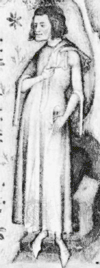
Guillaume de Machaut (about 1300-1377) was the most important French composer of the fourteenth-century. He was one of the first composers to compile his written manuscripts and make copies of them in order for them to be saved. These copies make him one of the first composers whose works have survived throughout the years. He wrote religious and secular compositions for many different occasions and about different subject matters. Machaut’s most famous composition was Messe de Nostre Dame (Notre Dame Mass or Mass of Our Lady). This work was one of the earliest polyphonic settings of the Mass Ordinary. The Mass Ordinary consists of texts that stay the same throughout the year and are not changed for special services. There are five parts, or sung prayers, to the mass ordinary. They are the Kyrie (Lord Have Mercy), Gloria, Credo (Creed), Sanctus (Holy, Holy, Holy), and Agnus Dei (Lamb of God). The Notre Dame Mass, as it is sometimes called, was written for four voices, some of which may have been doubled by or performed by instruments. We do not know how Machaut wanted his mass to be performed or which instruments he intended to be used to support the voices. We also do not know the occasion for which he wrote the Notre Dame Mass.
Please listen to the following sample from that great work: “Sanctus”
from Guillaume de Machaut's Messe de Notre Dame; from a 1954 recording by the
Roger Blanchard Ensemble.
This concludes Unit One, Music of the Middle Ages. It is from these
early beginnings that we have the music of today.
