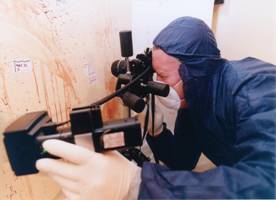
BODY
FLUIDS
UNIT OVERVIEW: This unit will introduce body fluids such as saliva, pus, perspiration, blood, semen, etc. and how these fluids can be used to help solve a crime. With the introduction of DNA into the crime-solving field, the science of serology has become an important aspect in solving crimes. In this unit, you will learn about the techniques for collecting and evaluating blood and other body fluids. You will even have the chance to make your own sample of FAKE BLOOD.
DIRECTIONS: Read the following text, look at the illustrations, complete the activities, and answer the questions. Key terms will be highlighted in bold print.
|
Key Terms |
||
|
biological fluids |
hepatitis |
HIV |
|
blood typing |
serology |
secretors |
|
non secretors |
castoff |
luminal |
|
presumptive test |
precipitin test |
indirect typing |
|
DNA |
target |
point of origin |
|
sequence of events |
mist |
Scalloping |

Body Fluids
![hm00442_[1]](SCIFSU07Body_Fluids_image005.png) One of the most negative aspects of crime
investigation involves the study of body fluids. Biological fluids as well as blood are found at
most crime scenes where violence has occurred.
Some examples of biological
fluids includes blood, saliva, tears, perspiration, pus, semen, and human
milk can all provide investigators with important identity information. When working with body fluids, there are
potential hazards. Hepatitis and the HIV
virus are two very good reasons for this concern. Hepatitis is an inflammation of the liver and
can be contagious. HIV, a virus that
causes AIDS, compromises the immune system.
Any individual who handles body fluids needs to wear surgical gloves
(exam gloves) when these fluids are found at the crime. In fact, it is required to wear gloves
anyway.
One of the most negative aspects of crime
investigation involves the study of body fluids. Biological fluids as well as blood are found at
most crime scenes where violence has occurred.
Some examples of biological
fluids includes blood, saliva, tears, perspiration, pus, semen, and human
milk can all provide investigators with important identity information. When working with body fluids, there are
potential hazards. Hepatitis and the HIV
virus are two very good reasons for this concern. Hepatitis is an inflammation of the liver and
can be contagious. HIV, a virus that
causes AIDS, compromises the immune system.
Any individual who handles body fluids needs to wear surgical gloves
(exam gloves) when these fluids are found at the crime. In fact, it is required to wear gloves
anyway.
Vital clues can come from the body fluids of the victim or the suspect. Crime labs do not yet allow for positive identification of an individual on the basis of body fluids alone. DNA fingerprinting, as of this period of time, is not considered 100% reliable by the courts. However, with the technology advancements in DNA matching, great strides will be made towards solving crimes.
The collection of body fluids and whether they will be useful to the forensic lab analyst depend upon a number of factors. Blood and semen are the most common of all body fluids found at the scene of a crime. Body fluids that are not dried need to be collected as soon as possible in order to provide purity and to prevent the degradation of the sample. Body fluids that are dry need to be removed from the object in question and sent to the crime laboratory.
 Developments in Genetic Coding:
Using Codas to Solve Crimes (02:11)
Developments in Genetic Coding:
Using Codas to Solve Crimes (02:11)
There have been many technological advances in blood analysis. Because of this technology, it is easier to subgroup the four basic blood groups; A, B, AB, and O. Blood type O occurs in 40 out of every 100 persons. Blood type A occurs in 40 out of every 100 persons. Blood type B occurs in 15 out of every 100 persons while blood type AB occurs in 5 out of every 100 persons. Blood typing classifies certain aspects of the blood into different categories. Blood type is an example where mathematical probability can be used to help solve identity. We know there are four major types of blood. Any human bloodstain can be identified as one and only one of the four types of blood in most cases. There are some rare types of blood but they are not prevalent in the population. Blood grouping is determined by the genetic makeup of the person.
Serology
Forensic serology is a field that has become quite important. The term serology is used in describing many tests that use body fluids. Blood is present at most serious or violent crime scenes so it can be studied in order to understand the sequence of events found at the crime scene. Blood can also be used as a link between the crime scene and a suspect or with a particular object found at the scene. The success of this field depends largely on the type of methods and techniques used to collect and preserve samples of blood and other body fluids.
We already know that almost everyone has either A, B, AB, or O blood types. There are certain proteins known as antibodies which make it possible to distinguish the blood type that is present in every type of cell in the body.
 In some cases these proteins are present
in enough quantity in saliva, semen, tears, urine, and perspiration to allow
the crime laboratory to determine the blood type of the person. The easiest method of establishing what is
known as blood classification is through blood typing.
In some cases these proteins are present
in enough quantity in saliva, semen, tears, urine, and perspiration to allow
the crime laboratory to determine the blood type of the person. The easiest method of establishing what is
known as blood classification is through blood typing.
Persons whose body fluids can be blood typed are known as secretors. Sixty-five to eighty per cent of the population is secretors. The rest of the population is known as nonsecretors. Their body fluids cannot be typed.
Both of these groups can be blood typed using their blood. Saliva, because of the high incidence of typing factors, is the easiest body fluid to type. Semen is usually a good source for blood type. Urine, tears, and perspiration are not as useful for blood type analysis because of the lower concentrations containing blood typing factors. Crime labs are able, in many cases, to identify blood type groups from saliva found on a glass or cigarette, and even from perspiration found on a garment’s fabric.
The Composition of
Blood
Understanding something about blood’s composition helps in appreciating the kinds of analyses that forensic serologists do and the kind of information that can be deduced from the results of these tests. Blood is a very complicated mixture of different kinds of cells dissolved in liquid substances. It consists of two phases, or parts: the cellular portion and the liquid portion. The liquid portion is called plasma.
The cellular portion of the blood contains three kinds of cells: red blood cells, white blood cells, and platelets. Red blood cells are the most numerous. White blood cells are less numerous and there are different kinds of them. These play a role mainly in fighting infections and in defense against diseases. Platelets, which are involved in blood clotting, are the third kind of cell-like element in blood. Plasma, the liquid part of the blood, contains a number of chemical substances. Blood cells are suspended in plasma and circulate in our body through a network of blood vessels, arteries, veins, and capillaries.
Once circulation is interrupted by an injury, through a gunshot, sharp instrument, or blunt force, bleeding will occur. Depending on the type of injury, its location, the force involved, the severity of the injury, and the environmental factors, a different type of bleeding will result. Once the blood leaves the human body and is deposited on a surface, it will eventually become a bloodstain. Bloodstains provide extremely valuable information to the forensic investigator. It is useful to focus on the nature of the blood drop itself, how it moves through the air, and how the pattern was produced, and where the blood source was at the time of the blood’s becoming airborne.

The Laws of Physics
Blood is a fluid that will always follow the laws of physics. As blood gathers on a surface in sufficient quantity, it will begin to form a drop. As the drop gets heavier, it will detach itself from that surface. As this happens the drop will form a spherical shape. It will not take on a teardrop shape, but will remain spherical in space until it drops onto a surface. Once a blood drop impacts the surface, a bloodstain will be formed.
Every drop falling from the same height, striking the same surface at the same angle of contact will produce a stain of the same basic shape. If any of these factors are changed, the shape of the bloodstain will change.
It has been determined that the volume of a blood drop is approximately 0.05 cc. While this is the average, not all blood drops are the same volume. Because the volume varies, you cannot simply measure the size of a stain and determine the exact distance that it has traveled. The velocity at which blood travels through the air becomes another critical factor. You should remember from physical science that velocity is the speed of motion. The terminal velocity of a blood drop has been determined at about 25 feet per second.
The distance blood drops determines the size and shape of the stain on impact. This impact area is called the target. The angle of the target has more effect on the shape of the stain than the distance fallen or the drop’s velocity of flight. Through careful observation, the angle at which blood drops hit the surface can be determined.
The texture of the target surface will also have an effect on the shape of the bloodstain. A blood drop impacting clean glass or plastic will produce a blood drop with smooth outside edges, the drop will maintain its surface tension, flatten out on the surface, and produce a circular and even stain. A blood drop impacting a rough surface, such as coarse paper, will cause the surface tension to break. This will produce what is called a “scalloping” on the edges of the stain. The outer edges will not be smooth, but uneven and pointed.

In the interpretation of bloodstain patterns, it is critical that one be able to determine, if possible, the direction from which the blood has actually traveled. This can determine the point of origin. Much of the forensic investigator’s job is to provide the detectives with data on what actually happened at a crime scene and how these events played themselves out. This information can also prove or disprove a suspect’s account.
The basic technique for determining stain angle, and one that permits the investigator to determine the point of origin, relies on measuring the stain and putting data through a geometric formula, using preprinted tables, a calculator, or laptop computer. Great care must be taken when measuring stains. Even a small error will result in a mistaken set of findings. The width measurement is almost always easier to make because the drop’s edges are usually well defined. The length measurement can be more difficult to obtain due to the separation of the tail. Remember, that all measurements are made in metrics.
By studying the bloodstains and other types of physical
evidence at the scene of the crime, the forensic scientist can also see where
one blood drop has overlapped another.
By determining which stain came first, along with the point of origin,
one can actually begin to develop the sequence
of events.
Several kinds of bloodstain patterns are commonly found and there is a breakdown of the different energy with which blood can be spattered. Mist is the term used to describe the high-velocity type of bloodstain. Though this blood residue is most commonly found as the result of a gunshot wound, mist can be caused by other high-energy impact sources. Fine drops can be produced in a number of ways, but are usually produced by forces greater than gravity. Medium blood drops can be produced in a variety of ways, either by gravity alone or through other kinds of forces. Large blood drops result from a wide variety of causes. The medium – to- large-size blood drops are commonly the result of blood naturally falling out of a wound or from a weapon due to simple gravitational forces. They are referred to as low-velocity blood drops.
Low-velocity impact spatter is created by a force at a speed of less than 25 feet per second. Blood affected only by gravity falls into this category. Medium-velocity impact spatter is that which is impacted with a force greater than 25 feet per second, but less than 100 feet per second and is usually associated with but not confined to gunshot wounds.
Formula to
Calculate the Volume of Blood
Fifty five % of blood is liquid and 45% is solid materials. We can estimate the amount of liquid blood by weighing blood crust at a crime scene and then multiply by the evaporation factor of the blood, using the following formula:
total weight of blood crust x 4.167 ml/mg = original volume
of blood
You will not need to know this formula. But just keep in mind how the volume of liquid blood is calculated.
Lab Potential for
Blood Analysis
Blood samples are collected by various methods and in different forms, so labs must be prepared to process the blood in various ways.
The blood lab will need what type of information is being sought by the C.S.I. in order to determine what type of test to perform. The blood lab analyst will determine if the substance is actually blood, and if not, what it is. They will also determine to what blood group the sample belongs. They will also look at the blood for alcohol or drug content. They will also determine if the blood was venous (from veins), fetal, or menstrual. They may also determine possible ways blood was deposited.
Blood as Evidence
in Court
Blood evidence may be used in a courtroom in a variety of ways. Numerous cases throughout the country have upheld the value and scientific reliability of blood pattern analysis. In forensic law, blood has always been considered class evidence, but the potential exists for individualized blood typing, and even today, forensic serologists can provide testimony with some strong probability estimates linking a single individual, and that individual only, to a bloodstain. Although the type of blood is not an indicator for positive identification of an individual, it can be used to exclude a person who is under suspicion of the crime. Blood can be collected in various ways such as:
|
-
in fluid form from a
pool of blood found at the crime scene |
|
-
from an alive or
dead victim |
|
-
in the form of dried
blood found on fabric or an object |
Sometimes the location of blood and bloodstains can be quite obvious; however, there are always places where a drop of blood can hide. These types of drops require special techniques and at times special chemicals to locate them. All articles found at the scene of the crime have the potential to have traces of blood on them. These items must be handled carefully so as to prevent contamination and preserve any other type of trace evidence.

The determination of the type and characteristics of blood, blood testing, bloodstain examination and preparation of testimony or presentations at trial are the main job functions of a forensic serologist, who also analyzes semen, saliva, other body fluids and may or may not be involved with DNA typing. Keep in mind that in many crime labs there is no real distinction between job title and job function. Some states have laws which make serological examinations admissible by statute without the necessity for testimony by an expert. The purpose of this is to insulate and protect their crime lab technicians. Other states rely on their medical examiner’s office, forensic pathologist, or board-certified toxicologist.
Often professors of biochemistry, hematology, and immunology are often “borrowed” as experts by both the prosecution and the defense.
In certain specialized areas that involve bloodstain examination, the courts will usually qualify someone as an expert who has no formal education but specialized training and has conducted a sufficient number of examinations and accumulated enough reference patterns to be able to demonstrate the basis of their opinion. These kinds of experts are most often law enforcement personnel.
What can
bloodstains reveal?
Sometimes useful information about how a crime occurred can be determined by the location, shape, and appearance of blood drops, splashes, or spatters. The shape of blood spots may give an estimate of the velocity, the angle of impact, the distance fallen from the source, or all three of these. The diameter of a blood spot is useful only for the first 5 or 6 feet from impact. Any distance beyond 6 feet shows very little reliable change in the spatter pattern. The degree of spatter from a single drop depends more on the type of surface on which it falls than on the distance it falls. If a surface is coarse, it is more likely the drop will rupture and spatter instead of landing as a round drop.

A conclusion about velocity and impact should not be drawn from a very small bloodstain. Very fine specks of blood may actually represent castoffs, satellites of larger drops of blood. However, when the smaller castoffs appear in great numbers, they may in fact have been caused by an impact of some sort -- the smaller the diameter of the droplet, the higher the velocity of impact.
Blood spatters can also indicate a victim’s position and the perpetrator at the time an attack took place. A considerable backspatter on walls, furnishings, or objects behind the victim is likely from a gunshot wound. Small, independent spatters usually have a uniform taper, in the shape of a teardrop. In these instances, the tail of the teardrop always points away from the direction of impact. Smaller castoffs usually tend to be longer and narrower than the teardrop shape of independent droplets. The sharper end of these stains always points back toward the direction of their impact.
Blood usually provides uniform patterns, regardless of the age or gender of the victim. Blood spattered from a body is at a constant temperature and is normally exposed to environmental conditions for only a short period of time. Atmospheric temperature, pressure, and humidity have little effect on the behavior of blood.

Bloodstain Analysis
The evidence of bloodstain analysis usually follows certain steps which serve to describe the various tests conducted.
The steps are:
|
- Is the sample blood? |
|
- Is the sample animal blood? |
|
- If animal blood, from what species? |
|
- If human blood, what type? |
|
- Can the sex, age, and race of the source of blood be determined? |
Is the sample blood?
Forensic scientists use color or crystalline tests to determine, if in
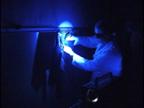
fact, it is blood. Luminol is used to detect invisible blood stains. Luminol is a chemical sprayed on carpets and
furniture which reveals a slight phosphorescent light in the dark where
bloodstains and other stains are present.
Dried blood has a tendency to crystallize. The generic term for determining if something
is blood or not is called a presumptive
test.
Is the sample animal blood?
If it is animal blood, from what species does it originate? Forensic scientists use antiserum or gel
tests to determine this. It is important
to test for animal blood because there is the possibility that the household
pet was injured. Pets normally spread
human bloodstains all around a crime scene, but the pet can be a victim,
perpetrator, or witness. Veterinary
forensics may be needed if pets are involved.
The test used to determine if the blood is human or not is called the precipitin test.
If it is human blood, what type is it? The first thing the C.S.I. must determine is if they have an adequate and quality sample. If that is the case, then direct typing using the ABO system is used. Indirect typing would be used on severely dried stains.
Can the sex, age, and race of the source of blood be determined?
Forensic scientists use various color and nitrate tests, as well as hereditary principles to estimate things like age, sex, and race. No exact determinations are possible; however, estimates of age, testosterone and chromosomes may help determine sex, and certain racial genetic markers. Racial genetic marker identification is a controversial topic.
Methods of Blood
Collection
The methods used to collect wet and dry blood samples must be carefully collected. All articles found at the scene of the crime have potential samples of blood on them. A clean razor blade is used to remove dried blood from an object. The razor blade and blood sample are placed inside a clean sheet of paper and placed in a marked envelope.
A sample of the unstained surface material near the recovered bloodstain should be removed as well and placed in a separate container to be used for comparison. This will assist the lab in proving that the results of the tests performed were brought about by the blood and not by the material on which it was deposited.
Small stains that cannot be scraped off may be removed by wiping the surface with a small piece of moist, clean filter paper. The filter paper is then placed in a test tube, sealed, and sent off to the lab. Blood found in cracks and on hard absorbent surfaces can be collected by using wet filter paper which is allowed to lie on the stained area. If the stain is on an upright bottle or can, a strip of filter paper is attached with a piece of tape and the top so as to allow it to lie over the stained area. A small amount of distilled water is added to the stained area. The stain will migrate up the filter paper carrying the blood with it in the process. The filter paper is removed from the object and placed into a marked test tube. The location of all bloodstains is carefully recorded in the sketch of the crime scene as well as on the evidence container.
Bloodstains that are found in soil need to be collected in a glass container and sent to the lab immediately since bacteria in the soil will destroy the evidence value. Clothing with wet stains must be wrapped so that the stains will not transfer to other areas of the garment. If the blood is transferred, it will not be possible to determine the position of the body during the time the bleeding occurred. Clean pieces of paper are used to prevent blood transfer from one piece of clothing to another during transport.
BLOOD TRIVIA:
· The study of blood is called hematology.
· White blood cells are larger than red blood cells and come in more sizes and shapes.
· Wet blood has more value than dried blood because more tests can be run.
· Blood is the most common, well-known, and perhaps most important evidence, in the world of criminal justice today.
· Blood begins to dry after 3 to 5 minutes of air exposure.
· Refrigerated red blood cells have a shelf life of about 42 days.
· Identical twins may have the same DNA profile, but completely different antibody profiles.
· The “O” blood type is most common among Aborigines, Native Americans, and Latin Americans. Donors with this type of blood can safely donate to anyone. Type “O” is called the universal donor.
· The “A” blood type is most common among Caucasians and those of European descent. Donors of type “A” can only donate blood to someone with the same type of blood.
· The “B” blood type is most common among African-Americans and certain Asians found in central Asia, as well as northern India. The people with type “B” blood have more of this than people of other races and places. Donors of this blood type can only donate to someone who has the “B” antigen. Among Native Americans, type “B” blood is very rare.
· The “AB” blood type is most common among the Japanese and certain Asians such as the Chinese. Persons with type “AB” can donate blood only to someone who has both the “A” and “B” antigens.
· Men generally have more red blood cells than women.
· A newborn baby has about half a pint (one cup) of blood in his/her body. An adult has roughly 10-15 pints of blood.
· Rare blood types exist in addition to the basic ABO system.
· An interesting phenomenon is that Middle Easterners are somewhat likely to have nucleated red blood cells, whereas normally, red blood cells contain no nucleus.
· Investigators can often estimate the time a crime occurred from how dry the blood is.
· There are 150 known proteins, 250 known enzymes, and many more antigens in blood.
Semen as Evidence
Semen stains are usually associated with sex crimes such as rape, but may also be present in other crime scenes as well. Wet seminal stains provide the lab analyst with a much better chance of analysis than the dry and fragile seminal stains.
The same procedures for collection of semen are also applied to blood collection. It is important to always handle semen stain areas as carefully as possible so that none of the spermatozoa present will be damaged. The C.S.I. must always remember to submit all swabs, smears, and stains removed from the victim during examination by a physician. Through DNA typing, it is possible to match semen stains with a person’s blood sample. When the examiner is looking at the semen samples, they will ask these questions:
|
-Does the stain contain human semen? |
|
-Can the blood group (A, B, O, and AB) of the stain be determined? If so, what is it? |
|
-If a blood specimen from the suspect is available, does it match the DNA present in the semen sample? |
FLUIDS TRIVIA:
Semen, saliva, or sweat can usually be found in splatters, drops, or stains.
Bodily fluids can be fresh, coagulated, or in dried form.
Each fluid has its own particular method of collection and preservation.
Bodily fluids, such as vomit, can be found at scenes involving alcohol, drugs, and poisons.
DNA
(Deoxyribonucleic Acid)
DNA profiling is more precise than fingerprinting and is
based on our genetic makeup. The term
“DNA fingerprinting” is a misnomer because it doesn’t distinguish between
identical twins the way fingerprinting does.
DNA typing was first begun to be adapted for criminal investigation
purposes in
DNA profiling examines small sections of human DNA known to vary among people. The arrangement is unique, with the exception of identical twins. Different segments of the chain are responsible for different characteristics in a person’s make-up, such as hair or eye color. What makes DNA so valuable to the science of crime-solving is that small segments of the double-helix may be isolated and printed on photographic film. These are then projected and looks rather like a bar code, and then these can be compared.
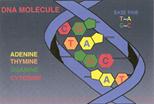
Unlike fingerprints, DNA is inherited, so that a segment of the chain will be identical in all blood relatives. DNA is not just found in blood, but anywhere white blood cells are found. These include fluids, skin, hair root follicles, and cells from saliva. It is actually easy to obtain a DNA sample, not from blood, but from the inside of the cheek where cheek cells are quite loose. In fact, you may have seen this procedure performed many times on television crime shows
DNA is quite durable. Under certain conditions it can survive for thousands of years, though it can deteriorate when exposed to radiation, such as sunlight. New techniques are being developed by the FBI that will allow C.S.I.’s the ability to use DNA more effectively to solve crimes. Although there are currently collection kits for DNA samples that include swabs and specific types of containers, at this point, it must all go from the crime scene to the lab for analysis. However, in the future that will change. Portable DNA analysis procedures are being developed that can go right to the crime scene and make a more automated and quick determination.
What about a DNA database? The FBI is creating a national DNA Identification Index. The national system, a database of DNA samples taken from felons, as well as body fluid evidence collected at crime scenes such as assaults, rapes, and homicides. Each state now has its own database and the FBI is in the process of connecting them all so that law enforcement agencies around the country can establish links among cases and identify victims.
DNA TRIVIA:
DNA is a 3-foot long
molecule that is tightly wound inside the 46 chromosomes in each cell of the
body.
Unit Extensions
This activity is optional, but is fun to do and is inexpensive. In fact, these items can be found in your home or at your local grocery store. Here is a basic recipe for FAKE BLOOD. This recipe is used by moviemakers in place of the real thing.
- 1 cup of light corn syrup
- 1 teaspoon red food coloring
- 1 drop green or blue food coloring
- 1 tablespoon clear dishwashing liquid
Mix and stir all ingredients. Test the FAKE BLOOD on an old rag to make sure it doesn’t stain. If it does, add more dishwashing liquid.
· Use the FAKE BLOOD to analyze blood spatter patterns. Use different surfaces on which to drop the blood. Try dropping the blood from various distances, walking, running, etc.
· Using what you know about blood analysis, how would you evaluate the drops? Even though this activity is optional, it is fun to do and really helps you learn to analyze blood drops. The ingredients in this recipe are sticky and may possibly stain, so be careful where you are using the FAKE BLOOD. Always clean up your mess! If you choose to complete this activity, you will have the opportunity to share your results in the question/answer section.
EXTENDED
There is an interesting article, DNA and a New Kind of Racial Profiling, which discusses the ability to racially profile, as well as the future DNA profiling in 15 years. The article discusses controversial issues concerning this topic but is well worth reading.
The article was published in Popular Science in December of 2003 and was written by Jessica Snyder Sachs.
Famous Crimes Revisited is written by Dr. Henry C. Lee and Dr. Jerry Labriola and is published by Strong Books in 2001. This book discusses legendary crimes of the 20th century with such cases as the Lindbegh baby, Sam Sheppard, John F. Kennedy, Jon Benet Ramsey, and O.J. Simpson. Sections of this book focus on DNA typing and blood analysis. It is well worth reading.
Forensic Sites to
Explore
3-D Crime Scene
https://www.forensic.to/webhome/paulb/
Forensic Careers to
Explore:
Forensic Serologist
Forensic Vet
Unit Conclusion
The future of forensic serology looks to the future with promising new discoveries that will aid in the solving of crimes. DNA obviously holds the key to future innovations can help to convict or eliminate a suspect. As new technologies become available, forensic serology will move to the forefront of crime detection.