Properties of Waves

Introduction
A wave is a disturbance that transfers energy from one place to
another in a regular and organized way. The surface waves that travel across
lakes and oceans are among the most familiar waves. Sound and light also travel
as waves, and the motion of all subatomic particles exhibits wavelike
properties. Some waves, such as radio waves, can be modified to carry
information. The study of waves is of great importance in physical science and
engineering.
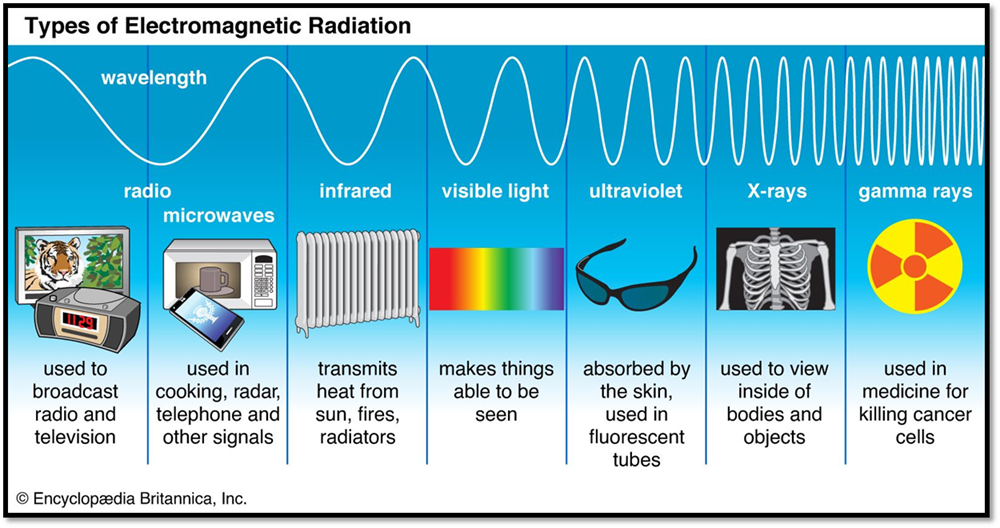
Electromagnetic
(EM) radiation is transmitted as transverse waves that can transfer energy
through matter and space.
Waves can be characterized in
several ways. For example, waves that must travel through a medium are called
mechanical waves. Sound waves and water waves are mechanical waves, as are
seismic waves. Electromagnetic (EM) waves—light, radio waves, microwaves, and
other electromagnetic radiation—do not require a medium and can travel through
a vacuum.
Wave Characteristics
Whenever you listen to music, use a
flashlight, or warm something in a microwave oven, you are using waves. A wave
is a traveling disturbance that carries energy through matter or space. Waves
transfer energy from one place to another.
Two Types of Waves
Transverse waves
In a transverse wave, the particles
move across, or perpendicular to, the direction the wave travels. Light, radio
waves, and microwaves are transverse waves.
Longitudinal waves
In a longitudinal wave, particles
of the medium vibrate back and forth, parallel to the direction the wave is
moving. Sound waves are examples of longitudinal waves. When a sound wave moves
from left to right, air particles collide with other nearby air particles and
form an area of compression. Then the first set of air particles moves to the
right. This leaves a space containing many fewer particles, called rarefaction.
Waves have several different
characteristics or properties, including amplitude, wavelength, and frequency.
Following is a brief description of these properties:
· Amplitude - the distance
between a wave’s resting point and trough or crest.
· Wavelength - the distance
between any two adjacent crests or any two adjacent troughs.
· Frequency - the
number of complete waves that pass a given point in a certain period of time.