 WESTERN EUROPE
ENTERS THE MIDDLE AGES
WESTERN EUROPE
ENTERS THE MIDDLE AGES
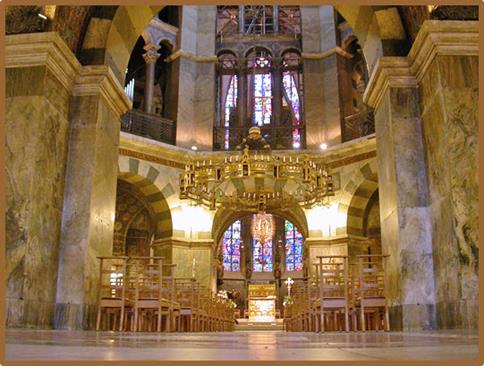
Charlemagne's
Palatine Chapel: Photo Courtesy of
Tobias Helfrick
Unit
Overview
While
the Muslims built their empire, Germanic tribes divided up Western Europe. Without Roman law and Roman military
presence, trade nearly disappeared, and cities decayed. City dwellers fled to the countryside and
struggled to survive. These events
marked the beginning of the Middle Ages or the Medieval Period, an era that
lasted for over one thousand years. It
was a time filled with highs, such as the reign of Charlemagne, and lows, like
the terrorizing raids of the Vikings.
Let’s see how it all happened.
Life
without the Roman Empire
By
500, the Germanic tribes had taken over the entire western sector of the Roman
Empire. Germanic kingdoms replaced Roman
provinces, and their borders changed constantly. The
Franks controlled Gaul, the Vandals
ruled North Africa, the Visigoths
held power in Spain and the Ostrogoths
were in charge of Italy. Britain, Rome’s
most distant province, was under constant attack from Angles, Saxons and Jutes. All
of these tribesmen were primarily farmers and herdsmen. They were accustomed to being governed by
unwritten customs as opposed to written laws.
This made them very different from the Romans.
The
constant state of warfare ruined trade and caused the decline of towns and
cities. The people who lived in them
were left defenseless and moved to the countryside where they grew their own
food to survive. These changes brought
about an era of history known as the Middle
Ages and began a way of life that would continue for nearly one thousand
years. It has also been called the Dark Ages and the Age of Faith.
As
Roman rule disappeared, Latin, the
common language of the empire, also changed.
When people from the German tribes entered the population, new words and
dialects developed. Soon French, Spanish,
Italian and other Roman-based or Romance
languages evolved. As more
individuals settled in rural areas, the importance of learning and education
decreased. By 800, Christian priests
were almost the only Europeans who could read and write.
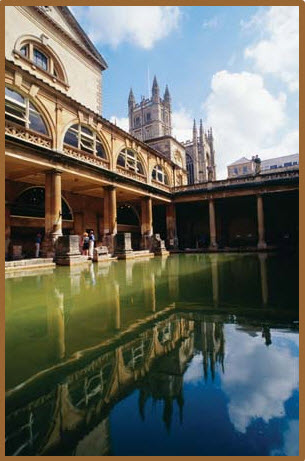
Remains of Roman Baths: Somerset, England
When
Roman law ceased to exist, the whole idea of government changed. The Germans did not see themselves as
citizens of a state but as members of a family that followed a particular
leader. Warriors pledged their loyalty
to certain chieftains or lords. The
lords gave their fellow tribesmen weapons, food and treasure as rewards for
their service. This created a personal
bond between the warriors and the lords, a practice that made orderly
government nearly impossible.
In
spite of the turmoil, one institution associated with the Roman Empire
survived. The Roman Catholic Church,
under the direction of the pope in Rome, remained strong and became the
civilizing force of the age.
Missionaries, such as Patrick
of Ireland, succeeded in winning converts to Christianity. Christian communities in which groups of men
or women gave up their possessions and lived simply became common. Women who chose to do this were called nuns and lived in convents. Men that followed
this way of life lived in monasteries
and were referred to as monks. They dedicated their lives to prayer and
worship. The monasteries operated schools, maintained libraries and copied
books. Through the efforts of monks,
some of Rome’s intellectual heritage survived.
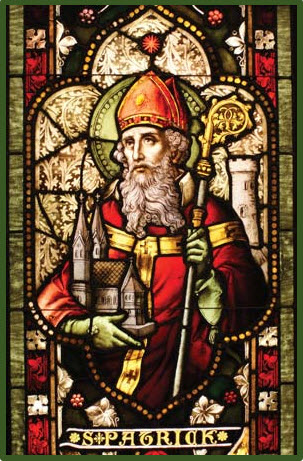
An
Artist's Rendition of St. Patrick in Stained Glass
The
Reign of Charlemagne
Although
the divisions among the German tribes were deep, a brief period of unity
occurred around 800. At this time, a
grandson of Charles Martel put together an empire that stretched across France,
Germany and part of Italy. At almost
seven feet tall, Charlemagne or
Charles the Great was an impressive figure.
During his forty-six year reign, he fought the Slavs in the east, the
Saxons in the west and the Muslims in Spain.
When Pope Leo III requested
help to defeat a group of rebellious lords, Charlemagne moved his troops into
Italy and ended the threat. To show his
gratitude, Pope Leo crowned Charlemagne as Emperor of the Romans in a ceremony
on Christmas Day, 800. This confirmed
that much of the old Roman Empire had been reunited under a single ruler. Charlemagne’s empire became known as the Holy
Roman Empire.
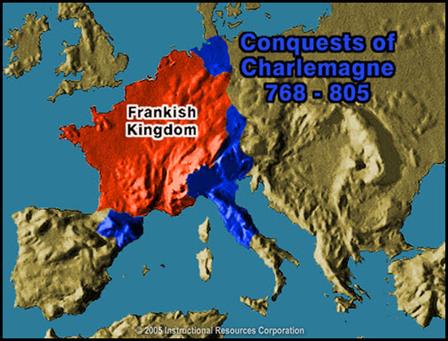
Map of Charlemagne's Empire
Charlemagne
was determined to unify Europe under the banner of Christianity, but this was
not an easy task. At first, he sent
missionaries to convert the Germanic tribes to the Christian faith. With the Saxons, however, this proved
ineffective. Ultimately, Charlemagne offered
his defeated enemies a choice. They
could be baptized as Christians or die by the sword immediately. Villages that rebuilt their pagan altars after
the emperor’s forces left town were destroyed.
For obvious reasons, the number of Christian converts soon increased.
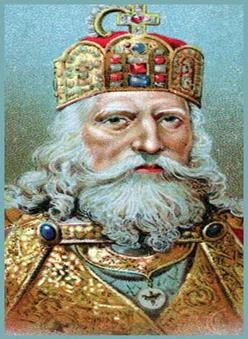
An Artist's Concept of Charlemagne
Charlemagne
realized that it was easier to manage his kingdom if he enlisted the help of
influential lords. He permitted them to
control large territories, but he knew that their power had to be limited. For this reason, Charlemagne sent royal
agents to make sure that the lords governed fairly and did not abuse their
authority. He journeyed to every part of
his realm annually. During these visits,
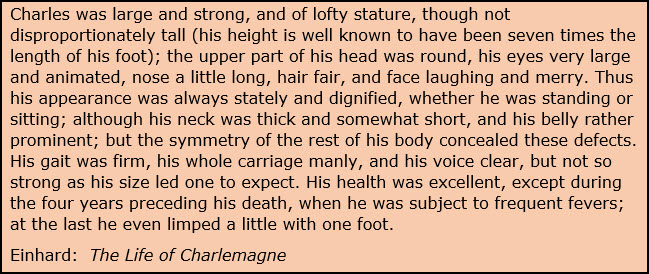
the emperor settled disputes and handed out rewards for good work. Einhard,
a historian living at the time and Charlemagne’s biographer, described him as
energetic, dedicated and hands-on leader.
Early
Germanic kings had little interest in education, but Charlemagne changed this
trend. He learned to read but found
writing very difficult to master.
Because he wanted his sons and daughters to be educated, Charlemagne
established a school within his palace and visited the classes regularly. Keeping a watchful eye on their progress in
reading, writing and math, Charlemagne demanded that his children take their
studies seriously and had no patience with laziness. Church officials were also expected to
improve their academic skills. For this
reason, the emperor encouraged monasteries to open schools and libraries. Monks made hand-written copies of books to
fill the library shelves. They produced
a beautiful style of lettering, known as Carolingian
miniscule. It is regarded as a rare
art form today.
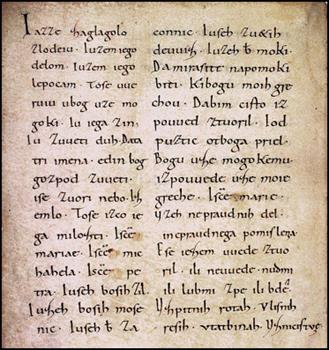
An Example of Carolingian Miniscule
Charlemagne
died in 814, and without his strong presence, his sons and grandsons engaged in
a bitter struggle for power. They
finally settled matters in 843 with the Treaty
of Verdun. This agreement destroyed
the empire by splitting it into three separate parts. Although his kingdom did not survive after
his death, Charlemagne’s reign had a lasting impact. Under his rule, Christianity reached the
northern areas of Europe and blended with German and Roman traditions. He also set an example of strong, efficient
government that later rulers applied to strengthen their own leadership.
New
Invasions
As
Charlemagne’s heirs argued among themselves, new waves of invaders hit Western
Europe. Even though Charles Martel,
Charlemagne’s grandfather, had defeated the Muslims at the Battle of Tours,
Islamic forces remained a threat. They
continued their attacks for the next one hundred years after Charlemagne’s death. At the same time, Magyars, a nomadic tribe struck from the east. Their raids devastated parts of Germany,
France and Italy, until they were finally driven out about 950.
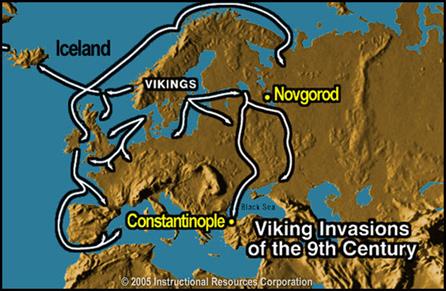
Map Showing the Viking Invasion Routes
The
most fearsome group, however, were the Vikings. They arrived from Scandinavia, a section of
Northern Europe that now includes of Norway, Sweden and Denmark. Beginning around 900, they plundered and
burned communities located along Europe’s seacoasts and river banks. Some of their long, lean ships carried as
many as three hundred warriors. The
Vikings or Norsemen traveled deep ocean waters and shallow rivers with equal
ease. Although they were destructive
raiders, they were also traders and explorers.
They opened new trade routes that linked Europe to the Mediterranean
region. This increased the exchange of
products and technology.
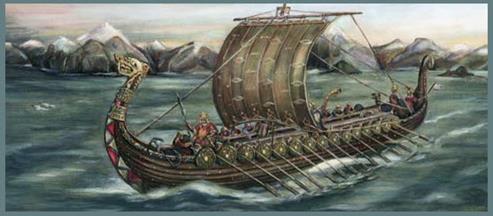
Painting of a Viking Ship
By
1000, the Viking raids subsided.
Europeans found ways to respond quickly and became better at fighting
off their attacks. Like the Germanic
tribes, the Vikings gradually accepted Christianity and no longer plundered
monasteries and churches. At last,
Europeans were not threatened by outside invasions, but they had learned the
importance of protection. Their desire
for security led them to rely on feudalism, a system that had advantages and
disadvantages.
What
Happened Next?
The
invasions of the Muslims, Magyars and Vikings had convinced Europeans that they
needed protection for themselves and their homes. Although Charlemagne was an exception, their
kings proved to be weak leaders and were unable to provide security. To meet their needs and to restore order,
Europeans relied on a different system called feudalism. Powerful lords exchanged land for promises of
loyalty and military service. Everyone
from nobles to peasants had a place in its hierarchy. In the next unit, you will see how knights,
castles and vassals fit into this way of life.
Before moving on, review the information in Unit 13; then, answer
Questions 21 through 30.