PHOTOSYNTHESIS and CHEMOSYNTHESIS
Continuing
with our topic of the cell we will now look at how some cells produce and use
energy. You should recall the characteristics of life (from unit 2) and one of
those characteristics being metabolism. Metabolism is the sum of all chemical
reactions carried out in an organism. These chemical reactions produce energy,
by building organic molecules, or require energy, by breaking down organic
molecules. Keep in mind, the energy, that is stored and used from these
reactions, is found in the chemical bonds of the organic compounds. In this
unit we will discuss the reactions which produce the energy needed to carry out
metabolism in all organisms. The next unit will discuss the reaction which uses
the energy that is produced or generated into a usable form the cell can use.
Remember that organisms which generate or produce their own energy, or food,
are autotrophs (self-feeder) and organisms which use the energy, or
food, produced by other organisms to generate cellular energy are heterotrophs
(other-feeder). The reactions we will discuss in this unit will involve
autotrophic organisms because these reactions involve producing organic
molecules that capture the energy from either the sun or inorganic molecules to
produce “food”.
ATP (Adenosine Triphosphate)
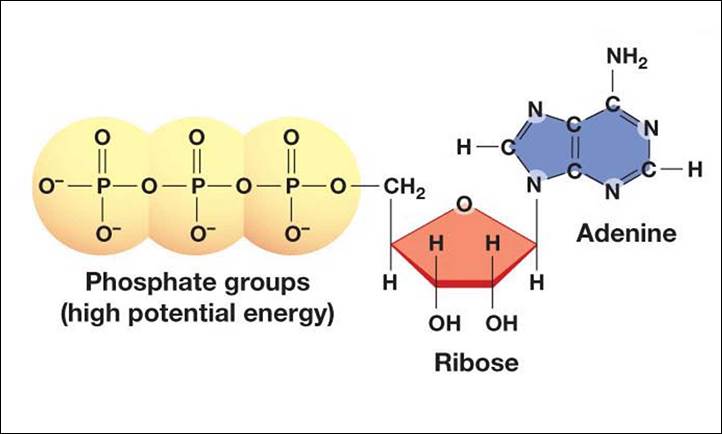
The
chemical nature of ATP was addressed in Unit 5. ATP is the energy “currency”
of the cell. When cells break down the food that is consumed, some of the
energy from the food is lost as heat. The energy not lost as heat is used to
produce ATP, so the cell has a usable form of energy for all of its
energy-required processes.
Hydrolysis of ATP
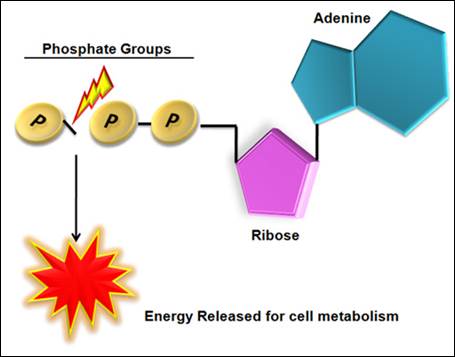

ATP has a
large amount of potential energy (stored energy) within the chemical bond of
the third phosphate group. In the hydrolysis decomposition reaction of ATP, the
chemical bond of the third phosphate group is broken and energy is released.
This energy will be used for any energy-required chemical process of the cell.
In the
reaction above you see ATP (adenosine triphosphate) being broken
down into an ADP (adenosine diphosphate) and P (phosphate
group broken off to release the energy from within the chemical bonds).

Synthesis of ATP
Many cells
have an enzyme that catalyzes the synthesis of ATP. [Catalyzes essentially means to bring about
or cause and synthesis means to produce or make.] The enzyme is called ATP
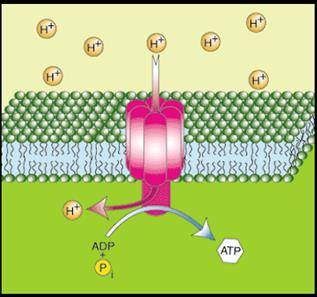
synthase. ATP synthase works by
recycling the ADP and P left over in the decomposition of ATP. ATP synthase chemically combines the ADP and
P producing ATP thus restoring the large amount of potential energy. ATP
synthase behaves as an enzyme and a channel protein. As hydrogen ions (H+)
move in or out of a cell through the ATP synthase in the membrane, the hydrogen
ions then power the ATP synthase to add a phosphate group to the ADP producing
ATP.
Chloroplasts
Chloroplasts
are the organelles which undergo photosynthesis. This organelle is responsible for converting
the energy from sunlight into an organic molecule (sugar) so it is said that
chloroplasts convert light energy into chemical energy. Chloroplasts can be
found in any photosynthetic autotroph, such as plants and some protists. A
common misconception about photosynthesis is that it takes place only in
plants. It is important to understand
that it can take place in any cell that contains chloroplasts, such as those
previously mentioned. Some bacteria undergo photosynthesis also, but remember
they do not have organelles, so they have no chloroplasts. Bacteria will
complete photosynthesis along their membrane.
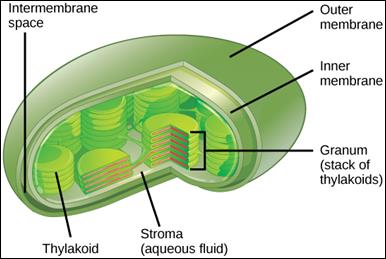
A
chloroplast is an oval organelle consisting of two membranes. The outer membrane is more permeable than the
inner membrane. Both membranes, however, allow light to pass through. The
fluid-filled space inside a chloroplast is called the stroma. Within the
stroma are flattened, disc-like sacs called thylakoids. The thylakoid’s membrane contain molecules
that absorb light energy and proteins for the chemical reactions involved in
photosynthesis. A stack of these thylakoids, of which there are many, is called
a granum or grana for plural.
 The light absorbing substance within a chloroplast (thylakoid more
specifically) is called a pigment. [Remember from physical science that
the color you see is what is being reflected and the other colors of the
spectrum that you do not see are being absorbed.] There are many different types of pigments
within photosynthetic cells.
The light absorbing substance within a chloroplast (thylakoid more
specifically) is called a pigment. [Remember from physical science that
the color you see is what is being reflected and the other colors of the
spectrum that you do not see are being absorbed.] There are many different types of pigments
within photosynthetic cells.
 Chlorophylls - There are 3 different forms of
chlorophyll: chlorophyll a, chlorophyll b, and chlorophyll c. Chlorophyll a is
the most abundant pigment in all photosynthetic organisms and absorbs blue and
red while reflecting mostly green and a little yellow. Chlorophyll b is similar to chlorophyll a,
but is not as abundant as chlorophyll a, while still reflecting green.
Chlorophyll b is found in plants and some protists. Chlorophyll c is found only
in some protists.
Chlorophylls - There are 3 different forms of
chlorophyll: chlorophyll a, chlorophyll b, and chlorophyll c. Chlorophyll a is
the most abundant pigment in all photosynthetic organisms and absorbs blue and
red while reflecting mostly green and a little yellow. Chlorophyll b is similar to chlorophyll a,
but is not as abundant as chlorophyll a, while still reflecting green.
Chlorophyll b is found in plants and some protists. Chlorophyll c is found only
in some protists.
Carotenoids - Carotenoids reflect red,
orange, or yellow. Carotenoids are called an accessory pigment because they
help the chlorophyll absorb light energy for photosynthesis.
Xanthophylls - Xanthophylls are similar to
carotenoids, but do not absorb energy as well as carotenoids. Xanthophylls
reflect red and yellow.
If you
ever noticed how leaves in certain parts of the country change color in the
fall it is due to these pigments and others. Chlorophyll is the primary pigment
for photosynthesis to produce sugar during the spring and summer with warmer
temperatures and longer days. With autumn, as the nights become longer the
chlorophyll production slows down and eventually stops. At this time the other pigments begin to show
their colors until their production also slows down and stops. To learn more
about this pigment change visit the link below:
http://na.fs.fed.us/fhp/pubs/leaves/leaves.shtm
Photosynthesis

The
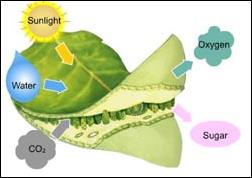
chemical reaction for photosynthesis is carbon dioxide (CO2) and
water (H2O) yielding oxygen (O2) and sugar, specifically
glucose, (C6H12O6) with the help of sunlight
and chlorophyll. Photosynthesis involves converting light energy into chemical
energy. The goal of photosynthesis is to
produce chemical energy in the form of an organic molecule, more specifically a
carbohydrate or sugar (glucose).
There are three overall stages to photosynthesis:
·
Stage 1: Light energy is captured.
·
Stage 2: The captured light energy is
temporarily stored as chemical energy.
·
Stage 3: The temporarily stored energy is
used in carbon dioxide fixation to produce an organic molecule (glucose).
Stage 1: Light energy is captured.
Splitting of Water
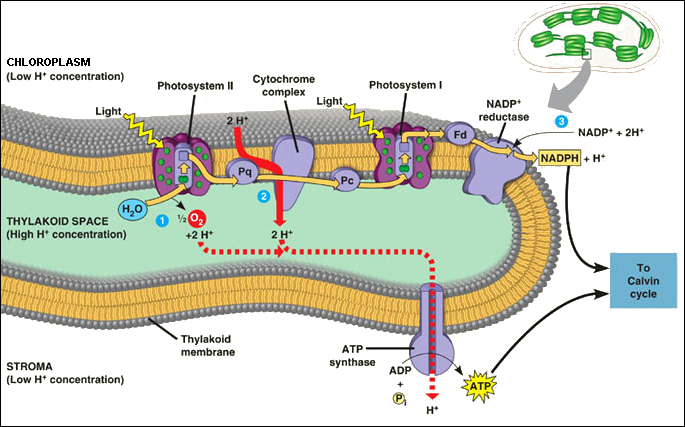
When sunlight strikes a thylakoid membrane the
energy from the sunlight is absorbed by the pigment molecules in the thylakoid
membrane. The electrons in the pigment
molecule are then “excited” by the energy of the sunlight and move to a higher
energy level. These excited electrons
then move to nearby molecules and to what are called electron carriers. When
the “excited” electrons leave the pigment molecule and travel down the membrane
they must be replaced. An enzyme in the thylakoid membrane will then split a
molecule of water and replace the “excited” electron with an electron from the
hydrogen atoms (H) in water (H2O). The resulting hydrogen ions
(H+) from the splitting of water will be released into the
thylakoid. The left-over oxygen atoms
from the splitting of water will combine and form oxygen gas (O2)
and be released from the cell into the atmosphere. We, as animals, are thankful for that because
that is the oxygen that we breathe.
Hydrogen Ion Pump
The “excited” electrons travel to nearby molecules
releasing their energy to pump hydrogen ions (H+) into the thylakoid
in the first of what is called Electron Transport Chains. By pumping hydrogen ions into the thylakoid a
concentration gradient is created. There is a higher concentration of hydrogen
inside the thylakoid and a lower concentration of hydrogen outside the
thylakoid. When this occurs hydrogen will naturally and passively diffuse out
of the thylakoid through the channel protein and enzyme known as ATP synthase. As you have read earlier in this unit, every
time hydrogen ions pass through an ATP synthase channel protein/enzyme ATP is
produced.
Producing NADPH
The “excited” electron used in the first electron
transport chain, for pumping hydrogen ions into the thylakoid, uses up all of
its energy and is absorbed into another chlorophyll molecule down the membrane.
The sunlight also “excites” electrons in this chlorophyll molecule to go into
the second electron transport chain. As these “excited” electrons leave
the chlorophyll molecule, they are replaced by the de-energized electrons from
the first electron transport chain. These new “excited” electrons chemically
combine hydrogen ions (H+) with an electron acceptor known as NADP+
to produce NADPH. NADPH (Nicotinamide adenine dinucleotide phosphate) is an
electron carrier which is responsible for carrying the high energy electrons
needed to store energy in the organic molecules (sugar) in the third step of
photosynthesis.
Stage 2: The captured light
energy is temporarily stored as chemical energy.
The end of Stage 1 provides us with ATP from the
first electron transport chain and NADPH from the second electron transport
chain. The ATP and NADPH produced is where the light energy is temporarily
stored as chemical energy. Both ATP and
NADPH will be needed and used to power the third step of producing the
energy-rich organic molecule which will be used as food for heterotrophs.
Stage
3: The temporarily stored energy is used in carbon dioxide fixation to produce
an organic molecule.
The first two stages of photosynthesis rely
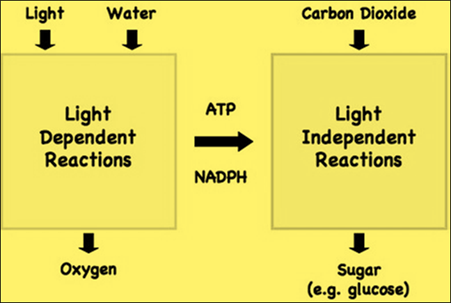
completely on sunlight in order to happen. Because of the need for sunlight,
stage 1 and stage 2 are referred to as the light dependent or light
reactions. The third stage is referred
to as the light independent or dark reactions, because the energy needed
from sunlight was already used and chemically stored in stages 1 and 2, now
stage 3 can occur without the need for sunlight.
The ATP and NADPH produced in stage 2 will now be
used to produce energy-storing organic molecules known as carbohydrates or
sugars (glucose) from the carbon atom in carbon dioxide (CO2). Using
the carbon atom in carbon dioxide to produce organic molecules is known as carbon
dioxide fixation. There are many ways photosynthetic organisms perform
carbon dioxide fixation, but the most common method or process is known as the Calvin
Cycle.
Factors that
Affect Photosynthesis
There are
three factors that affect photosynthesis: light intensity, carbon dioxide
concentration, and temperature.
·
Light
Intensity: The rate
of photosynthesis increases as light intensity increases until all of the
pigments in a chloroplast are being used. Once all of the pigments are being
used there is nothing left to absorb the light energy.
·
Carbon
Dioxide Concentration: Carbon
dioxide concentration is similar to light intensity because once a saturation
point is reached, the rate of photosynthesis cannot be increased or, in other
words, go any faster.
·
Temperature: Photosynthesis involves many
chemical reactions which require enzymes. Enzymes, being proteins, require a
certain temperature range in order to function properly. If the temperature
increases or decreases too much the enzyme will not function properly,
therefore, the chemical reaction will not occur.
CHEMOSYNTHESIS
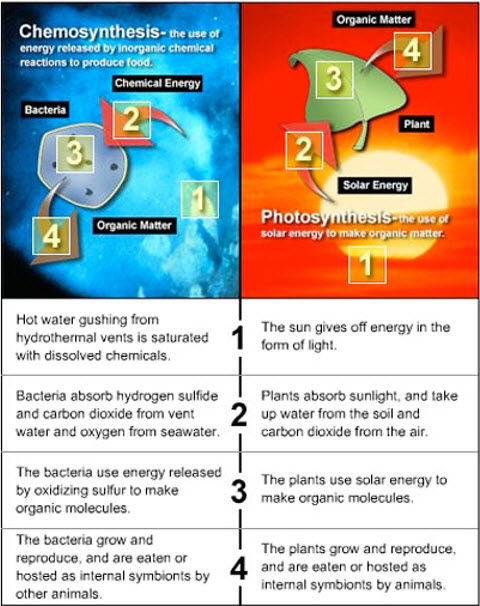
Chemosynthesis
is another type of reaction that creates chemical energy. This type of reaction requires inorganic
molecules to produce the chemical energy, not sunlight. This type of reaction
is a rare reaction as it is only done by bacteria found deep in the ocean near
hydrothermal vents or oceanic crust ridges. Since bacteria are prokaryotes with
no nucleus or more importantly no organelles, there is no organelle to perform
chemosynthesis. Instead, chemosynthesis occurs
on their cell membrane. As was already
stated, chemosynthesis does not require or use sunlight, instead it uses the
inorganic molecule hydrogen sulfide (H2S) or in some cases methane
(CH4). The hydrogen sulfide along with oxygen (O2) and
carbon dioxide (CO2) will produce the high energy molecule sugar (CH2O)
for the organisms deep in the ocean to feed on for energy.

Photosynthesis and Chemosynthesis Worksheet
UNIT VOCABULARY
REVIEW
Click on the Quizlet icon below to access the quizlet.com vocabulary flash
cards. Review the vocabulary before completing your assessment.

 Now answer questions 1 through 20.