 THE INDUSTRIAL
REVOLUTION COMES TO AMERICA
THE INDUSTRIAL
REVOLUTION COMES TO AMERICA
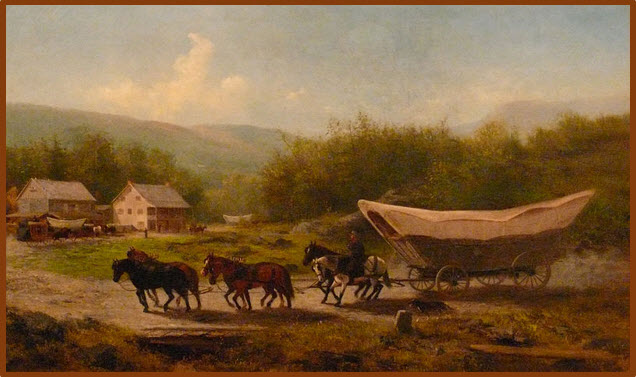
The Conestoga
Wagon: A Common Vehicle on the National
Road
Unit
Overview
By
1800, the Industrial Revolution had spread from Great Britain to America. Water-powered machinery replaced hand-held tools
and transformed the making of cloth from a home-based industry into a factory
operation. Technology and the factory system soon produced a wider variety of
goods more efficiently and at a lower cost.
Marketing these products in the West encouraged the construction of
roads and canals to connect the eastern seaboard with the western
frontier. Let’s see how it all happened.
New
England and the Industrial Revolution
In
the mid-1700s, several British inventors developed machines to do some of the work
associated with the making of cloth.
Because this equipment ran on waterpower, cloth-making factories, called
textile mills, were built along
rivers and streams. As the number of
manufacturing plants increased, more people left their farms to earn steady
wages as industrial workers. This series
of developments became known as the Industrial
Revolution.
In
an attempt to keep their new, industrial technology a secret, the British
government passed laws to prevent their machinery and skilled mechanics from
leaving the country. The legislation,
however, was impossible to enforce.
Enterprising individuals soon found ways to carry the advancements
beyond British borders. In 1789, Samuel Slater worked in a British
factory that spun cotton into thread with the help of machines invented by Richard Arkwright. Slater memorized Arkwright’s designs and left
for America. When he was hired to manage
a textile mill in Rhode Island, Slater duplicated Arkwright’s equipment and
produced cotton thread at a much lower cost.
The United States had taken the first step in becoming an industrialized
country.
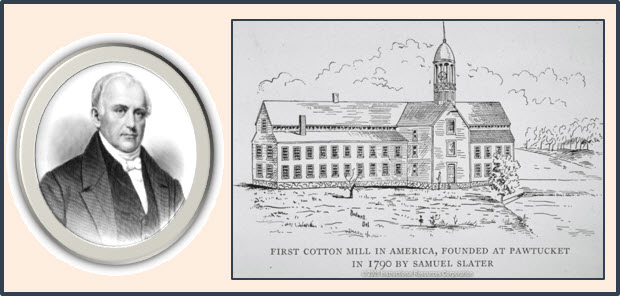
Samuel Slater and his
First American Textile Mill
Factory
owners in Massachusetts, Vermont, New Hampshire and Connecticut soon following
Slater’s example. Because New England’s
poor soil and shorter growing season often made farming difficult, people were
willing to leave their fields and find work elsewhere. The region also had the rapidly moving
streams and rivers necessary to run the new machinery. New England’s harbors were another
advantage. Cotton arrived on ships from
the southern states, while finished cloth left on vessels bound for other areas
of the country or Europe.
 The Industrial Revolution Comes to America
The
textile industry continued to streamline manufacturing with the use of
technology. In 1814, Francis Cabot Lowell opened, the Boston
Manufacturing Company, a textile plant, in Waltham, Massachusetts. By using what is now known as the factory system, he housed all the
processes of spinning thread and making cloth under one roof for the first
time. The entire operation of converting
raw cotton to cloth was coordinated to increase efficiency and to lower
cost.
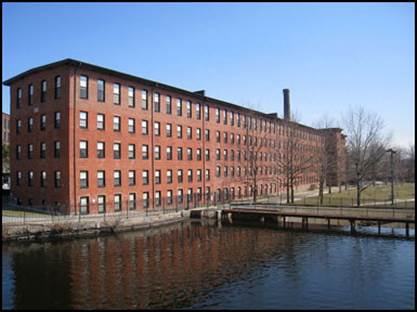
Boston Manufacturing Company: National Historic Site
At
the same time, American manufacturers adopted Eli Whitney’s idea of interchangeable
parts, which was first used to assemble rifles. With this technique, identical, machine-made
parts could be put together by unskilled workers to make a total product. The use of interchangeable parts made it
possible to produce a wider variety of goods on a larger scare and to sell them
at a cheaper price. This inspired
inventors to create more machinery to replace hand-operated tools. To protect an inventor’s interests, Congress
passed a patent law in 1790. A patent gave an inventor the legal
rights to the invention and to its profits for a certain period of time.
 Go to Questions 1 through 5.
Workers
in Industry
The
shift to power-driven machines in factories changed the way people lived and
worked in the United States. While these
industries employed some workers skilled in a particular craft, most hired unskilled
laborers. They worked long hours for low
wages. There were no safety standards or
laws to prevent unhealthy working conditions.
The noise level was earsplitting, and workers found themselves doing the
same tasks over and over. Some textile
mills employed entire families; others preferred to hire as many children as
possible. They worked the same hours as
the adults, but they were paid lower salaries.
About one-half of American textile workers were under the age of sixteen
in the 1820s. Textile operations owned
by the Lowell family were staffed by young, unmarried women, who lived in
company-owned dormitories near the plant.
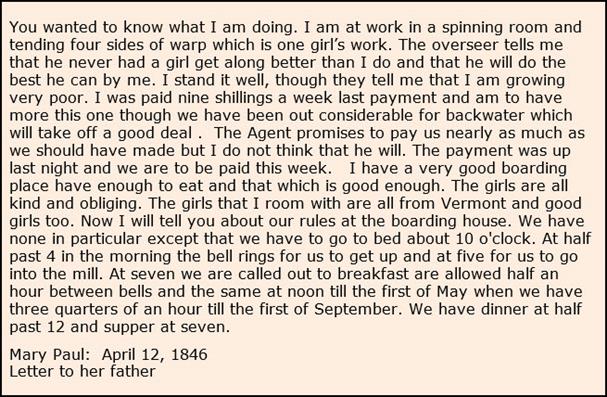
The Lowell Girls, who
composed 80% of the mill’s employees, worked to help their families or to save
money for their marriages. The letter quoted in the graphic below was written
by Mary Paul who worked as a Lowell Girl.
Immigrants from foreign
lands were also a source of labor for American industrialists. Between 1820 and 1840, almost six million
newcomers arrived in the United States.
The majority came from Germany
and Ireland. Many German immigrants brought enough money
to buy farms or to establish businesses in the cities of the West. The Irish, however, often arrived with little
money and settled in the cities of the Northeast. Many had been farmers who rented their land
and lost everything when Ireland’s potato crop failed for several years. Because the potato was one of Ireland’s chief
sources of food, over one million men, women and children died of
starvation. In spite of low wages and
unsanitary conditions, American factories offered Irish immigrants a chance for
survival.
 Go to Questions 6 through 10.
The
Demand for Cotton
Although
many New Englanders worked in factories, more than 65% of Americans made their
living as farmers. Farms in the
Northeast were usually small, and most of what they produced was marketed
locally. In the South, on the other hand,
cotton production increased
dramatically during the first half of the 1800s. The growth of the textile industry in the
United States and Europe steadily increased the demand for this product. Southern plantation owners purchased enslaved
Africans to plant, tend and pick the cotton crop. The invention of the cotton gin by Eli Whitney made it possible to clean raw cotton faster
and in greater quantity. You can see how the device worked by watching the
video below.
The Cotton Gin
Because
the cotton gin made the crop more profitable, plantation owners throughout the
South planted more cotton. The amount
harvested annually increased from 3,000 bales to 300,000 bales between 1790 and
1820. Southerners continued to export their crop to northern textile mills
rather and chose not to construct their own factories. The emphasis on growing cotton, however,
drained the soil of its nutrients. This
encouraged southern planters to look for additional land in the West and
promoted the expansion of slavery.
Go to Questions 11.
The
Need for Better Roads
By
1820, thousands of Americans were moving across the Appalachian Mountains and
into the West. Once they established
farms, western settlers looked for better routes to transport their crops to
eastern markets. At the same time,
eastern industrialists wanted to get their manufactured goods to western
customers. Unfortunately, it was obvious
to everyone that the nation’s roads were in poor condition. Rocks, mud, fallen trees and holes made
travel difficult and often impossible at certain times of the year. Wet weather turned roads to muddy bogs, and
dry weather created clouds of dust.
Techniques for building better roads had been developed in Great
Britain, and American engineers followed their example. They added drainage ditches to remove excess
water and topped roads with tightly packed gravel.
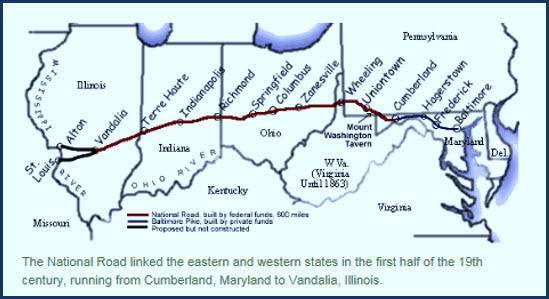
Map Showing Towns
along the National Road: Courtesy of the
National Park Service
Many
roads were built with private funds. The
owners of these routes charged a toll
or a fee for the use of the road.
Collection gates, also called pikes,
were placed at intervals along the way.
The gates were usually on a hinged pole across the roadway, and guards
swung the gates open once the toll was paid.
These privately owned roads were called turnpikes.
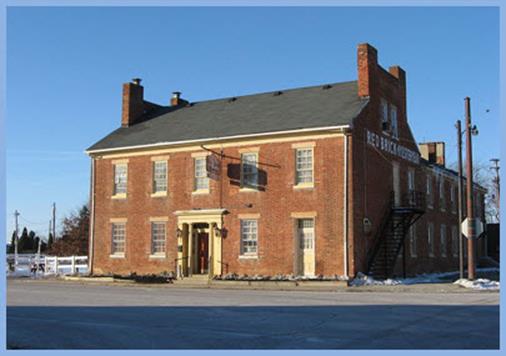
Red Brick
Tavern: Built in 1837 to Serve Travelers
on the National Road
Although
turnpike construction boomed during the first two decades of the nineteenth
century, there was still no good road to connect the eastern section of the
United States with the area west of the Appalachian Mountains. The project was simply too expensive to be
undertaken by state governments or private builders. In 1806, Congress approved federal funding
for the National Road to tie the
Midwest to the eastern seaboard. Construction
began at Cumberland, Maryland in 1811 but was interrupted by the War of
1812. The National Road stretched to
Wheeling, Virginia (now West Virginia) in 1818 and reached Vandalia, Illinois
by 1839.
 Go to Questions 12 through 14.
The
Canal Age
Although
new roads speeded mail delivery, reduced travel time and made stagecoach rides
more comfortable, they did not meet all of the nation’s transportation
needs. Moving big items or large
quantities of goods between East and West was still very expensive and
slow. It was cheaper to ship by water,
but most major rivers in the United States flowed north to south rather than
east to west. It was also very difficult
to travel upstream against the current.
Things improved when Robert
Fulton developed a steamboat with a powerful engine. Although the success of the Clermont
and other steamships greatly improved shipping and travel on inland rivers,
their routes were dependent on the existing river networks. To solve these problem, Americans built canals, man-made waterways that were
used to make connections between two bodies of water.

Section of the Original Erie Canal: Photo Courtesy of D.A. Sonnenfeld
In
New York, Governor DeWitt Clinton
devised a plan to link New York City with the Great Lakes by building a canal
between the towns of Albany and Buffalo. Thousands of workers, including many Irish
immigrants, were employed to construct the 363-mile Erie Canal. The channel opened on October 26, 1825 after
two years of continuous digging. For its
official opening, Clinton boarded a boat in Buffalo on Lake Erie, journeyed
through the Erie Canal and traveled down the Hudson River to New York City.
To learn more about why and how the canal was built, watch the videos
listed below.
Why Build the Erie Canal?
Construction of the Erie Canal
The
Erie Canal immediately reduced the cost of shipping one ton of cargo from the
Hudson River to Lake Erie from $100 to $15.
The success of the Erie Canal resulted in an explosion of canal
construction. Within thirty years, the
United States had acquired more than 3,600 miles of canals. Along with lowering the cost of transporting
goods, the canals increased trade and population in towns and cities along
their routes. Cleveland, Detroit,
Chicago and Buffalo all benefitted from the surge in canal-building, and New
York City became the biggest commercial center on the Atlantic Coast. The map pictured below shows the major canals
built between 1790 and 1850.
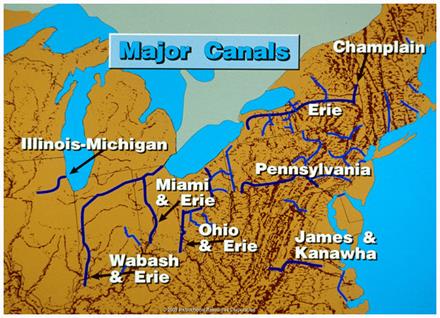
 Go to Questions 15 through 17.
Growing
Towns and Cities
An
increase in the number of factories, improvements in transportation and a
larger volume of trade drew more people to American cities. New industrial towns also grew rapidly as the
demand for workers continued. With the
exception of Philadelphia, cities and towns expanded without zoning laws or
city codes. It was not unusual to find
barnyard animals roaming through unpaved streets. There was no garbage collection, and most
urban areas had no sewers to remove waste water. Diseases, such as typhoid, yellow fever and
cholera, sometimes reached epidemic proportions and killed thousands of
people. Fire posed a serious threat to congested
cities that did not have organized fire departments. Flames easily spread from one cheaply
constructed building to another. In
1834, New York experienced a major fire that caused millions of dollars in
property damage and bankrupted several insurance companies.
Poor
living conditions and low wages sometimes resulted in unrest and destructive
riots. The Flour Riot, which occurred in New York in 1837, was one
example. On a cold, winter day, a crowd
that included large numbers of Irish immigrants gathered to protest a recent
increase in the price of flour. This
impacted almost every household, because it was the main ingredient purchased
to make bread. Suspecting that a local
businessman was stockpiling flour to drive up the price, the protestors stormed
his store and warehouse. Over 400
barrels of flour and thousands of sacks of wheat were destroyed before the New
York militia drove the crowd away. Read
an excerpt from an eyewitness account quoted in the graphic below.
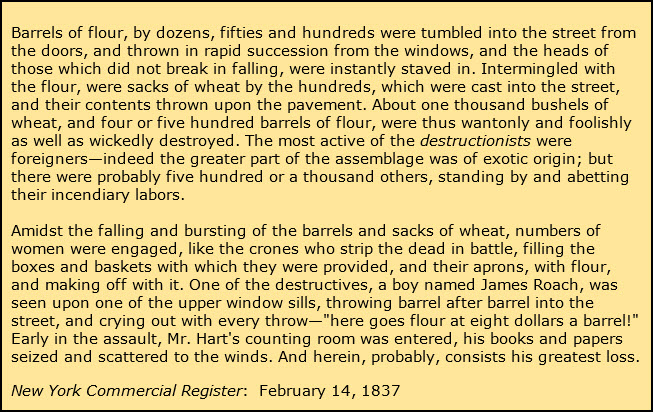
In
spite of their flaws, there were some advantages to living in the cities and
towns. They offered not only jobs in
factories but employment in grocery stores, bakeries, hotels and stables. As the cities continued to grow, they added
libraries, museums and theaters. For
many, the positive aspects of city life outweighed the negative ones.
 Go to Questions 18 through 22.
What
Happened Next?
Like
his predecessors, James Monroe chose not to run for a third term. After a close election that was decided by
the House of Representatives, John Quincy Adams became president in 1825. His chief opponent, Andrew Jackson, won the
office in 1828 following a campaign filled with mudslinging and vicious
attacks. Jackson and Congress clashed
over slavery, economic issues and the power of the executive branch. Before examining Jackson’s impact on American
politics and presidential power in the next unit, review the names and terms
found in Unit 22; then, complete Questions 23 through 32.
 Go to Questions 23 through 32.
 |
| Unit 23 Industrial Revolution |
| Unit 23 Time Machine (1870): The cotton gin and its inventors Article and Quiz |
| Unit 23 The Industrial Revolution and the Growth of Cities Article and Quiz |
| Unit 23 What's the Big Idea? Worksheet |