Life, liberty, and the pursuit of happiness are ideas that united early Americans and formed the bedrock of a young nation. In this unit, you will learn how these principles helped inspire many of America's greatest symbols of democracy.
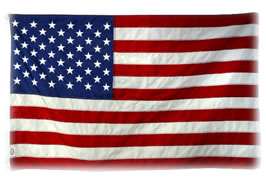
The U.S. flag has gone through many changes since the first official flag of 1777. On June 14, 1777, the Continental Congress passed the first Flag Act, which said that the flag would be made up of thirteen alternating red and white stripes and thirteen white stars on a blue field. Stars have been added to the flag as new states join the union. Currently, the flag contains 50 stars.
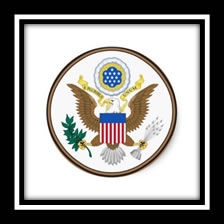
Ever wonder why the flag is red, white, and blue? While the flag's colors did not have a specific meaning at the time, the colors were important for the Great Seal of 1782.
White: means purity and innocence
Red: means valor and bravery
Blue: means Vigilance, perseverance, and justice
Why stars and stripes? Stars are considered a symbol of the heavens and the divine goal to which man has hoped; the stripe is symbolic of the rays of light coming from the sun.
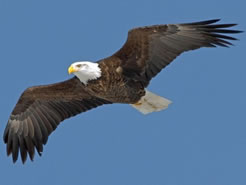
The Founding Fathers wanted to choose an animal that was unique to the United States. The bald eagle was chosen as the emblem of the United States of America in 1782. It was chosen because of its long life, great strength, courage, freedom and majestic looks.
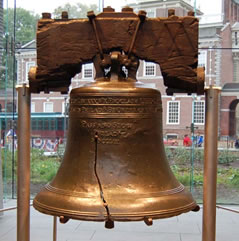
The Liberty Bell is a symbol of American Independence. It is located in Pennsylvania. It weighs 2000 pounds. The Liberty Bell was rung on July 8, 1776, to summon everyone to come to Independence Hall in Philadelphia to hear the first public reading of the Declaration of Independence. It is no longer used and is on display. It has a distinctive crack in it.
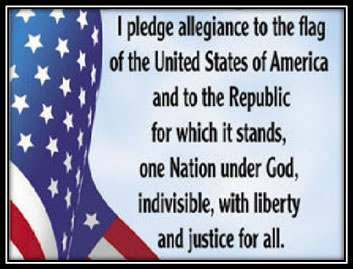
The Pledge of Allegiance was first published in 1892 in The Youth's Companion magazine in Boston, Massachusetts to celebrate the 400th anniversary of the discovery of America. The Pledge received official recognition by Congress as an Act approved on June 22, 1942. The phrase "under God" was added to the Pledge by a Congressional act approved on June 14, 1954.
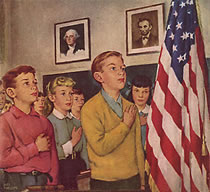
When delivering the Pledge of Allegiance, all must be standing at attention, facing the flag with the right hand over the heart. Men not in uniform should remove any nonreligious headdress with their right hand and hold it at the left shoulder, the hand being over the heart. Persons in uniform should remain silent, face the flag, and render the military salute.
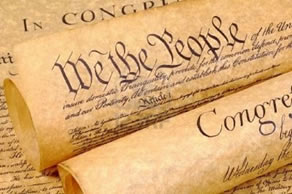
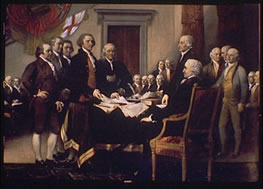
The Declaration of Independence was a desperate cry for freedom. The British colonists living in America had grown used to being independent in many ways. They thought that the British Parliament and its King, George III, were making too many laws that took away too many of their freedoms.
Early in 1776, while the troops were fighting in the field, more delegates were meeting in Philadelphia, at the Second Continental Congress. This Congress went on for months, and out of it came the Declaration of Independence. The American people had had enough. The delegates decided that they wanted to declare themselves independent from Great Britain. They appointed a committee of five people to write a document. Those five people were John Adams, Benjamin Franklin, Thomas Jefferson, R.R. Livingston, and Roger Sherman. The main author was Thomas Jefferson.
On June 28, the committee presented the Declaration to the Continental Congress. After a series of debates, the Congress approved it. On July 4, John Hancock, president of the Congress, signed it. The document itself was not signed by all 56 signers until much later. But Congress declared it in effect on July 4. This was in the middle of a war. The Americans had forced the British to leave Boston, but many bad losses were to follow. The Americans had to fight long and hard to keep their independence. Still, the signing of that document gave them all a common cause, something they could fight for and defend with their very lives. This is why we celebrate Independence Day each year on July 4.
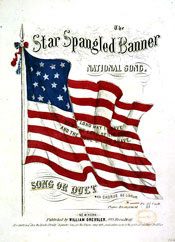
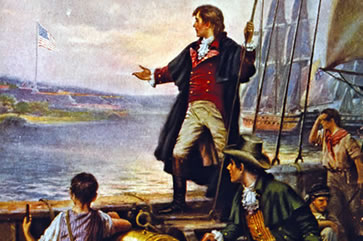
During the War of 1812, on September 13, 1814, Francis Scott Key visited the British fleet in Chesapeake Bay to secure the release of Dr. William Beanes, who had been captured after the burning of Washington DC. The release was completed, but Key was held by the British overnight during the shelling of Fort McHenry, one of the forts defending Baltimore. In the morning, Key peered through clearing smoke to see an enormous American flag flying proudly after a 25-hour British attack of Fort McHenry. He was so delighted to see the flag still flying over the fort that he began a poem to commemorate the occasion, with a note that it should be sung to the popular British melody "To Anacreon in Heaven."
In 1916, President Woodrow Wilson ordered that it be played at military and naval occasions. In 1931, the Star-Spangled Banner became our national anthem.
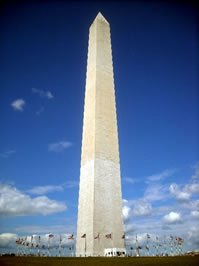
George Washington was the first president of the United States. He was born in 1732. He was a soldier and a good leader. With his leadership, America won the Revolutionary War. He was much beloved.
The Washington Monument, a four-sided stone structure, was built between 1848 and 1884 as a tribute to George Washington’s military leadership from 1775-1783 during the American Revolution. The Monument weighs 81, 120 tons, and stands approximately 555 feet tall it towers over everything in Washington, DC and is one of the tallest masonry structures in the world. Fifty flags surround the base of the Washington Monument and symbolize the 50 states of the Union. If you take the elevator to the pyramid top, windows in the observation room offer views of the Lincoln Memorial, the White House, the Thomas Jefferson Memorial, and the Capitol building.
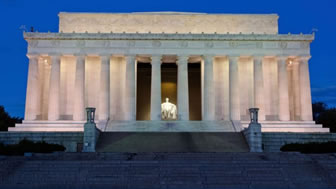
Abraham Lincoln was the 16th president of the United States. He was born in Kentucky in 1809. He led the country through the Civil War, preserving the Union and ending slavery. He was assassinated in April 1865 at Ford’s Theatre in Washington, D.C.
The Lincoln Memorial commemorates the life of Abraham Lincoln. The memorial, which was built between 1914 and 1922, symbolizes his belief that all people should be free. It is located in Potomac Park, Washington, D.C. The theme of the building represents the Union. The columns surrounding the walls stand for the 36 states in the Union at the time of Lincoln’s death. The names of the 48 states in the Union (when the memorial was completed in 1922) are carved on the walls along the outside of the memorial. A plaque honoring Alaska and Hawaii is in the approach plaza.
The chamber inside the memorial contains a statue of Lincoln seated, facing the Washington Monument and the Capitol. The statue of Lincoln is 19 feet high and weighs 175 tons. The chamber also houses two huge stone tables, one engraved with Lincoln’s Second Inaugural Address, and the other with the Gettysburg Address. Two murals represent the principles of freedom, justice, unity, brotherhood, and charity.
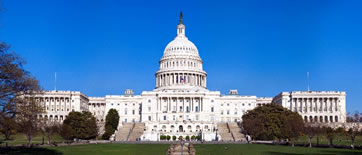
The United States Capitol Building is one of the most impressive landmarks in the country. It sits on Capitol Hill on the east end of the National Mall, a national park in downtown Washington, D.C. The United States Capitol has been the home of both the U.S. House of Representatives and the Senate since 1800. The iron dome, also white, is surmounted by a statue of a woman representing Freedom, by the American sculptor Thomas Crawford. The height of the Capitol from the baseline on the east front to the top of the statue is 287.5 feet.
Let’s Sing Along with the Teacher and the Rockbots: Symbols of America Song (03:32) to review what we have learned!
 |
| Unit 33 U.S. Symbols Activity |