Law of Sines and Law of Cosines
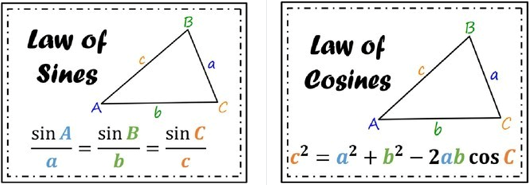
Law of Sines
Section Overview
● Understand and apply the Law of Sines to find unknown
measurements in right and non-right triangles.
Key Vocabulary:
Degree - An angle measure.
Radian - Arc measurement.
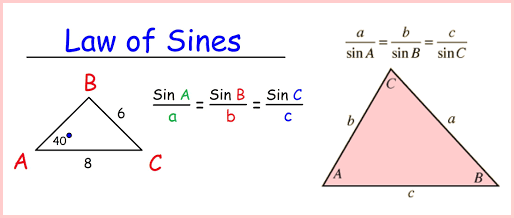
The law of sines relates the ratios
of side lengths of triangles to their respective opposite angles. This ratio
remains equal for all three sides and opposite angles. We can therefore apply
the sine rule to find the missing angle or side of any triangle using the
requisite known data.
Law of Sines Formula:
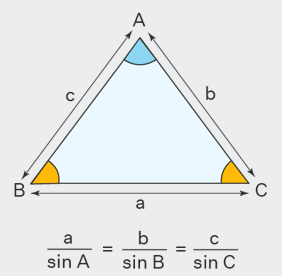
Solution: For the given data, we can use the following formula of sine law:
a/sinA = b/sinB = c/sinC
20/sin A = 25/sin 42°
sin A/20 = sin 42°/25
sin A = (sin 42º/25) × 20
sin A = (sin 42º/25) × 20
sin A = (0.6691/5) × 4
sin A = 0.5353
A = sin-1(0.5363)
A = 32.36°
Answer: ∠A = 32.36°
Example 2: Solve for x.
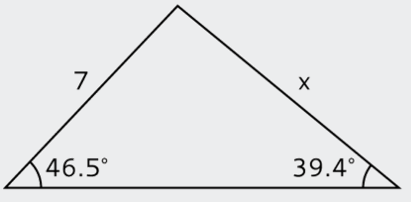
Solution:
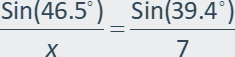
7 Sin(46.5°) = x sin (39.4°)
7 (0.725) = x (0.635)
5.078 = x (0.635)
x = 8
Let’s Practice.
Solve
triangles using the law of sines (practice) | Khan Academy
Law of Cosines
Section Overview
· Recall the law of cosines, a2 = b2 + c2
– 2bc cos A.
· Recognize how the law of cosines can be applied to a triangle to
determine an unknown side length (given a diagram or otherwise).
· Recognize how the law of cosines can be applied to a triangle to
determine an unknown angle measure (given a diagram or otherwise).
Key Vocabulary:
Initial side - Starting point.
Terminal side - Ending point.
Central Angle - Angle formed by 2 radii.
The Law of Cosines is used
to find the remaining parts of an oblique (non-right) triangle when either the
lengths of two sides and the measure of the included angle is known (SAS) or the
lengths of the three sides (SSS) are known. In either of these cases, it is
impossible to use the Law of Signs because we cannot set up a solvable
proportion.
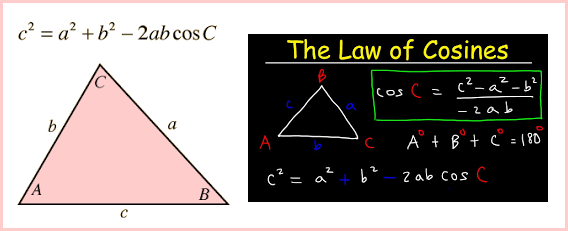
The Law of Cosine states that: c2 =
a2 + b2 – 2ab cosC.
This resembles the Pythagorean Theorem except for the third term and
if C is a right angle the third term equals 00 because the
cosine of 90° is 0 and we get the Pythagorean Theorem. So,
the Pythagorean Theorem is a special case of the Law of Cosines.
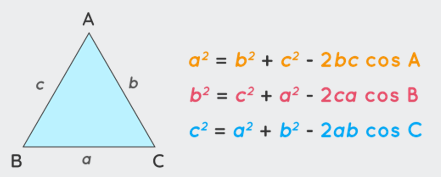
The Law of Cosines can also be stated as:
b2 = a2 + c2 – 2ac cosB OR a2 = b2 +
c2 – 2bc cosA
Law of Cosines Formula:
Example 1: Two Sides and the Included Angle-SAS
Given a = 11, b = 5 and m∠C = 20°. Find the remaining side and
angles.
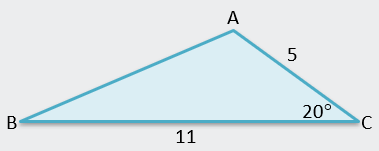
c2 = a2 +
b2 – 2ab cosC
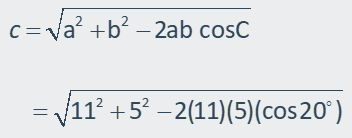
» 6.53
Example 2: Three Sides-SSS
Given a = 8, b = 19, and c
= 14. Find the measures of the angles.
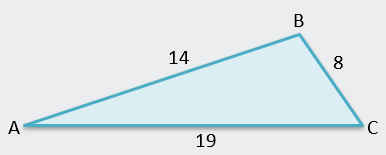
It is best to find the angle
opposite the longest side first. In this case, that is side b.

Since cos B is
negative, we know that B is an obtuse angle.
B » 116.80°
Since B is an obtuse angle and a
triangle has at most one obtuse angle, we know that angle A and
angle C are both acute.
To find the other two angles, it is simplest to use the Law of Sines.
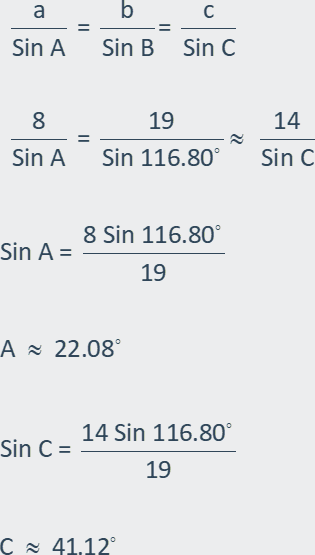
Let’s Practice.
Solve
triangles using the law of cosines (practice) | Khan Academy