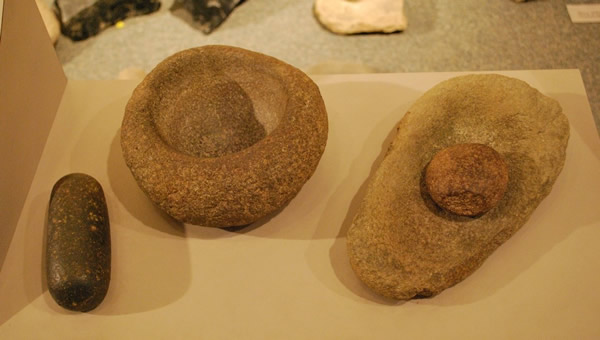
Stone mortar and pestle
AMERICAN INDIANS IN OHIO
Unit Overview
In this unit, students will learn that various groups of people have lived in Ohio over time including American Indians. Interactions among these groups have resulted in cooperation, conflict and compromise. Prehistoric (Paleo, Archaic, Woodland, Late Prehistoric) and historic (Delaware, Miami, Ottawa, Seneca, Shawnee and Wyandot) American Indians were the original inhabitants of Ohio. While information on prehistoric groups is somewhat limited, there is evidence of cooperation involving the construction of mounds and trade with distant groups. In addition, there is evidence of conflict, especially among the Late Prehistoric groups as they sometimes fought over access to hunting territories or the most fertile agricultural lands.
American Indian Culture
Video: Watch this BrainPOP video to learn about American Indians, their society and their culture!
History Timeline of the Native Indians of Ohio
10,000 BC: Paleolithic Age (Old Stone Age) - the Indians hunted and gathered for food and followed the routes of several camps and relied on the different seasons.
7500 BC: Neolithic Age (New Stone Age) – the Indians began farming and ranching. Some crops that were grown were squash, pumpkin, tobacco, corn, and beans. They built basic shelters and made stone weapons and stone tools.
1700 BC: Mound Builders culture - a feature of many Woodland Indian tribes. Two of these mounds in Ohio are called "Serpent Mound" and "Alligator Mound”.
AD 1000: Woodland Period - including the Hopewell cultures established along rivers in the Northeastern and Midwestern United States which included trade exchange systems and burial systems.
Stone mortar and pestle
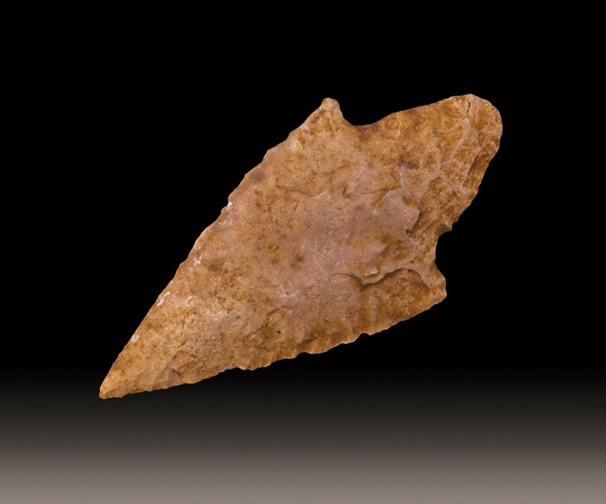
Stone arrowhead
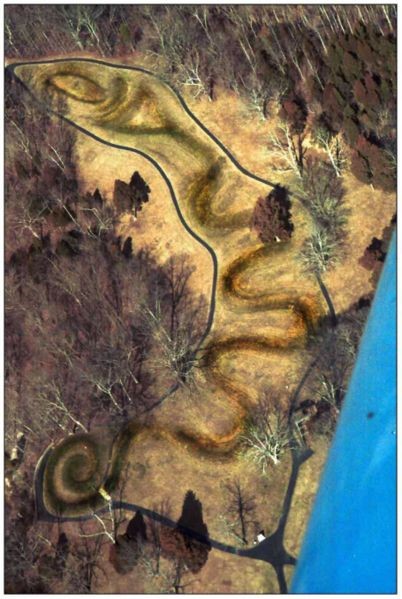
Aerial view of Serpent Mound
In Ohio, there were a wide variety of Indian cultures and languages. American Indians were the earliest known inhabitants of Ohio. The Eastern Woodlands Indians were groups of Indians who lived in Ohio and were in a transitional stage between Paleolithic Age (Old Stone Age) and Neolithic Age (New Stone Age). The Eastern Woodlands Indians in Ohio were made up of the Shawnee, Miami, Delaware, Mingo, Wyandot, Huron, and Ottawa tribes.
Government - The Indians’ form of government was “primitive” and a “direct democracy”. All the men of the tribe formed the Tribal Council. The Tribal Council was made of the Main Chief and the war chiefs. The Main Chief was selected by age and amount of wisdom he possessed while the war chiefs were selected for bravery, youth, and vigor.
Property - Personal property was recognized such as weapons, tools, and clothing. The land was held in common among all the Indians of a tribe and belonged to the Great Spirit.
Warfare - The Indians engaged in violent activities such as scalping which is the removal of the scalp. The hair exposed the skull and was the trophy of the human hunt. Torture and mutilation were very common and defeated enemies were often enslaved. Europeans were often shocked after experiencing warfare and torture with the Indians and many ended up resenting the Indians because of these practices.
Religion - Common beliefs of Eastern Woodlands Indians were animism and dreams. Animism was the belief that every living thing has a soul and that inanimate objects have spirits which can be persuaded or placated. The Indians worked to do this by engaging in proper conduct so they would not offend the spirits. If they believed that they had offended the spirits, the Indians would perform rituals to please or ward the spirits. Religious leaders were called shamans. Dreams were seen as omens or ways to foretell the future.
Let's practice! Take this BrainPOP quiz to review American Indians, their society and their culture.
American Indian Population Decline
The Indians suffered the greatest decline in population in history after coming into contact with Europeans (90% loss of population between the years 1500 – 1900). By the time the English arrived in North America, disease had already spread to the Indians from Mexico and Central America who had been in contact with the Spanish. The population of Central Mexico pre-Columbus was estimated at 11 million people. The Spanish census in the early 1600s showed that the Indian population was down to 2.2 million people.
There are several reasons for the rapid decline in population among the American Indians. Epidemic diseases were the main reason but war and being driven from their land also contributed. Why were Indians affected so much more severely than Europeans by these diseases? Europeans were more disease-experienced, meaning they had been exposed to many more diseases and had built up immunities, whereas the Indians hadn’t. Some of the diseases were: whooping cough, measles, chicken pox, tuberculosis, cholera, and small pox. The number one disease that killed the Indians was small pox.
Review
After completing this unit, review the following checklist to make sure you can do all of the following:
_I can give examples of cooperation among prehistoric groups.
_I can give examples of conflict among prehistoric groups.
_I can sort interactions between “conflict” and “cooperation.”
_I can provide historic examples of how cooperation can solve a problem experienced by one or more groups.