Course Overview
In this course students learn about cell specialization, biotechnology, DNA, evolutionary theory, equilibrium of systems, electromagnetic radiation, isotopes, radioactive decay, and concepts of forces and motion as applied to large and small objects and energy levels. Integrated with these topics are historical perspectives, the process of inquiry, the nature of science, ethical practices and the use of appropriate technology. Students apply the principles of forces and motion and describe and predict the net effects of forces and motion of objects or systems. Students explore scientific research, scientific literature, and the relationship of science and society.
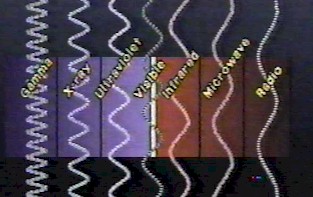
ELECTROMAGNETIC
RADIATION
Unit Overview
Explain how information about
the universe is inferred by understanding that stars and other objects in space
emit, reflect or absorb electromagnetic radiation, which we then detect.
Unit Directions
Read and study the following
unit carefully, and then answer the test questions that appear at the
conclusion of the unit.

In terms of classical theory,
electromagnetic radiation is the flow of energy at the universal speed of light
through free space or through a material medium in the form of the electric and
magnetic fields that make up electromagnetic waves such as radio waves,
visible light, and gamma rays. In such a wave, time-varying electric and
magnetic fields are mutually linked with each other at right angles and
perpendicular to the direction of motion. An electromagnetic wave is
characterized by its intensity and the frequency v of the time variation
of the electric and magnetic fields.
In terms of the modern
quantum theory, electromagnetic radiation is the flow of photons
(also called light quanta) through space. Photons are packets of energy hv
that always move with the universal speed of light. The symbol h is
Planck's constant, while the value of v is the same as that of the
frequency of the electromagnetic wave of classical theory. Photons
having the same energy hv are all alike, and their number density
corresponds to the intensity of the radiation. Electromagnetic radiation
exhibits a multitude of phenomena as it interacts with charged particles in
atoms, molecules, and larger objects of matter. These phenomena, as well as the
ways in which electromagnetic radiation is created and observed,
the manner in which such radiation occurs in nature, and its technological
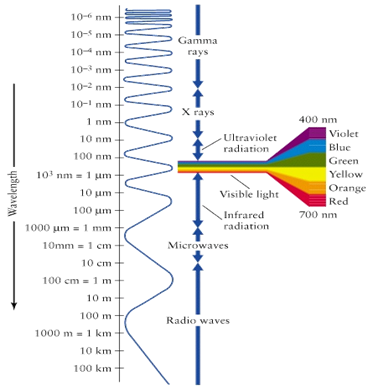
uses, depend on its frequency v. The spectrum of frequencies of electromagnetic
radiation extends from very low values over the range of radio waves,
television waves, and microwaves to visible light and beyond to the
substantially higher values of ultraviolet light, X rays, and gamma rays.
The basic properties and
behavior of electromagnetic radiation are discussed in this unit,
as are its various forms, including their sources, distinguishing characteristics,
and practical applications. The unit also traces the development of both the
classical and quantum theories of radiation.
 Introducing Electromagnetism (05:30)
Forms of
Electromagnetic Radiation: Microwaves
The microwave region extends
from 1,000 to 300,000 MHz (or 30-centimetre to one-millimetre wavelengths).
Although microwaves were first produced and studied in 1886 by Hertz, their
practical application had to await the invention of suitable generators, such
as the klystron and magnetron.
Microwaves are the principal
carriers of high-speed telegraphic data transmissions between stations on the
Earth and also between ground-based stations and satellites and space
probes. A system of synchronous satellites about 36,000 kilometres above the
Earth is used for international broadband telegraphy of all kinds of
communications—e.g., television, telephone, and telefacsimile (FAX).
Microwave transmitters
and receivers are parabolic dish antennas. They produce microwave beams
whose spreading angle is proportional to the ratio of the wavelength of the
constituent waves to the diameter of the dish. The beams can thus be directed
like a searchlight. Radar beams consist of short pulses of microwaves.
One can determine the distance of an airplane or ship by measuring the time it
takes such a pulse to travel to the object and, after reflection, back to the
radar dish antenna. Moreover, by making use of the change in frequency of the
reflected wave pulse caused by the Doppler effect (see above Speed of
electromagnetic radiation and the Doppler effect), one can measure the
speed of objects. Microwave radar is therefore widely used for guiding
airplanes and vessels and for detecting speeding motorists. Microwaves can
penetrate clouds of smoke, but are scattered by water droplets, and so are used
for mapping meteorologic disturbances and in weather forecasting.
Microwaves play an increasingly wide role in heating and cooking
food. They are absorbed by water and fat in foodstuffs (e.g., in the
tissue of meats) and produce heat from the inside. In most cases, this reduces
the cooking time a hundredfold. Such dry objects as glass and ceramics, on the
other hand, are not heated in the process, and metal foils are not penetrated
at all.
The heating effect of
microwaves destroys living tissue when the temperature of the tissue
exceeds 43° C (109° F). Accordingly, exposure to intense microwaves in excess
of 20 milliwatts of power per square centimetre of body surface is harmful. The
lens of the human eye is particularly affected by waves with a frequency
of 3,000 MHz, and repeated and extended exposure can result in cataracts.
Radio waves and microwaves of far less power (microwatts per square centimetre)
than the 10–20 milliwatts per square centimetre needed to produce heating in
living tissue can have adverse effects on the electrochemical balance of the brain
and the development of a fetus if these waves are modulated or pulsed at low
frequencies between 5 and 100 hertz, which are of the same magnitude as brain
wave frequencies.
Various types of microwave
generators and amplifiers have been developed. Vacuum-tube devices, the
klystron and the magnetron, continue to be used on a wide scale, especially for
higher-power applications. Klystrons are primarily employed as amplifiers in
radio relay systems and for dielectric heating, while magnetrons have been
adopted for radar systems and microwave ovens. (For a detailed discussion of
these devices, see electron tubes.) Solid-state technology has yielded
several devices capable of producing, amplifying, detecting, and controlling
microwaves. Notable among these are the Gunn diode and the tunnel (or Esaki)
diode. Another type of device, the maser (acronym for “microwave
amplification by stimulated emission of radiation”) has proved useful in such
areas as radio astronomy, microwave radiometry, and long-distance
communications.
Astronomers have discovered
what appears to be natural masers in some interstellar clouds.
Observations of radio radiation from interstellar hydrogen (H2) and
certain other molecules indicate amplification by the maser process. Also, as
was mentioned above, microwave cosmic background radiation has been detected
and is considered by many to be the remnant of the primeval fireball postulated
by the big-bang cosmological model.
Properties of Electromagnetic Waves (02:46)
How Radar Detectors Work:
Radar Basics
To understand how radar
detectors work, you first have to know what they're detecting. The concept of
measuring vehicle speed with radar is very simple. A basic speed gun is just a
radio transmitter and receiver combined into one unit. A radio transmitter is a
device that oscillates an electrical current so the voltage goes up and
down at a certain frequency. This electricity generates electromagnetic
energy, and when the current is oscillated, the energy travels through the
air as an electromagnetic wave. A transmitter also has an amplifier that
increases the intensity of the electromagnetic energy and an antenna that
broadcasts it into the air.
A radio receiver is just the
reverse of the transmitter: It picks up electromagnetic waves with an antenna
and converts them back into an electrical current. At its heart, this is all
radio is -- the transmission of electromagnetic waves through space.
Radar is the use of radio
waves to detect and monitor various objects. The simplest function of radar is
to tell you how far away an object is. To do this, the radar device emits a
concentrated radio wave and listens for any echo. If there is an object
in the path of the radio wave, it will reflect some of the electromagnetic
energy, and the radio wave will bounce back to the radar device. Radio waves
move through the air at a constant speed (the speed of light), so the radar
device can calculate how far away the object is based on how long it takes the
radio signal to return.
Radar can also be used to
measure the speed of an object, due to a phenomenon called Doppler shift.
Like sound waves, radio waves have a certain frequency, the number of
oscillations per unit of time. When the radar gun and the car are both standing
still, the echo will have the same wave frequency as the original signal. Each
part of the signal is reflected when it reaches the car, mirroring the original
signal exactly.
But when the car is moving,
each part of the radio signal is reflected at a different point in space, which
changes the wave pattern. When the car is moving away from the radar gun, the
second segment of the signal has to travel a greater distance to reach the car
than the first segment of the signal. As you can see in the diagram below, this
has the effect of "stretching out" the wave, or lowering its
frequency. If the car is moving toward the radar gun, the second segment of the
wave travels a shorter distance than the first segment before being reflected.
As a result, the peaks and valleys of the wave get squeezed together: The
frequency increases.
Based on how much the
frequency changes, a radar gun can calculate how quickly a car is moving toward
it or away from it. If the radar gun is used inside a moving police car, its own
movement must also be factored in. For example, if the police car is going 50
miles per hour and the gun detects that the target is moving away at 20 miles
per hour, the target must be driving at 70 miles per hour. If the radar gun
determines that the target is not moving toward or away from the police car,
than the target is driving at exactly 50 miles per hour.
Police officers have been
catching speeders this way for more than 50 years. Recently, many police
departments have added a new sort of speed detector, one that uses light
instead of radio waves. In the next section, we'll see how these cutting edge
devices work.
Lidar

In the last section, we
looked at the conventional radar guns police have been using since the 1950s.
These days, more and more police departments are using laser speed guns rather
than conventional radar. The basic element in a laser speed gun, also called a lidar
gun (for light detection and ranging), is concentrated light.
The lidar gun clocks the time
it takes a burst of infrared light to reach a car, bounce off and return back
to the starting point. By multiplying this time by the speed of light, the
lidar system determines how far away the object is. Unlike traditional police
radar, lidar does not measure change in wave frequency. Instead, it sends out
many infrared laser
bursts in a short period of time to collect multiple distances. By comparing
these different distance samples, the system can calculate how fast the car is
moving. These guns may take several hundred samples in less than half a second,
so they are extremely accurate.
Smile for the
Camera!
Police may use handheld lidar systems, just like conventional radar guns, but
in many areas, the lidar system is completely automated. The gun shines the
laser beam at an angle across the road and registers the speed of any car that passes
by (the system makes a mathematical adjustment to account for the angle of
view).
When a speeding car is
detected, the system triggers a small camera, which takes a picture of the
car's license plate and the driver's face. Since the automated system has
collected all of the evidence the police need, the central office simply issues
a ticket and sends it to the speeder in the mail.
In the next sections, we'll
see how detector devices help speeders evade radar and lidar speed traps. We'll
also find out what the police can do to figure out who's using a radar
detector.
Picking up
Signals
In the previous sections, we saw how police use traditional radar as well as
new laser technology to catch drivers speeding. As it turns out, conventional
radar is relatively easy to detect. The simplest radar detector is just a basic
radio receiver, something like the one you use to pick up FM and AM radio
stations.
The air is full of radio
signals -- they're used for everything from television broadcasts to garage
door openers -- so for a receiver to be at all useful, it must pick up only
signals in a certain range. The receiver in a radio is designed to pick up
signals in the AM and FM frequency spectrum, whereas the receiver in a radar
detector is tuned to the frequency range used by police radar guns.
Periodically, the frequency range used by the police is expanded, and
speedsters everywhere have to invest in new detection equipment.

A basic radar detector won't do
you much good if the police officer drives up behind you and turns on the radar
gun. The detector will alert you, but by that time, the officer already has all
the information he or she needs. In many cases, however, detectors pick up the
signal before the speeding car can be tracked. Police often leave their radar
guns turned on for a long period of time, instead of activating them after
sneaking up behind a car.
Radar guns have a cone- or
dish-shaped antenna that concentrates the radio signal, but the electromagnetic
wave quickly spreads out over a wide area. The radar gun is configured so that
it only monitors the speed of a particular target, not everything in the
vicinity, so chances are a detector will pick up the radio signal well before
the radar gun recognizes the car.
Of course, with this sort of
detector, you're relying mostly on the luck of the draw -- if the police
officer decides to target you before any other car, you're caught.
 Now answer questions 1-11.
For additional information on
How Radar Works click on this link http://www.radarworld.org/works.html
to view the Home Page click PDF File